
Apple Opens First Store in Noida at DLF Mall of India, Signs ₹65 Crore Lease for 11 Years

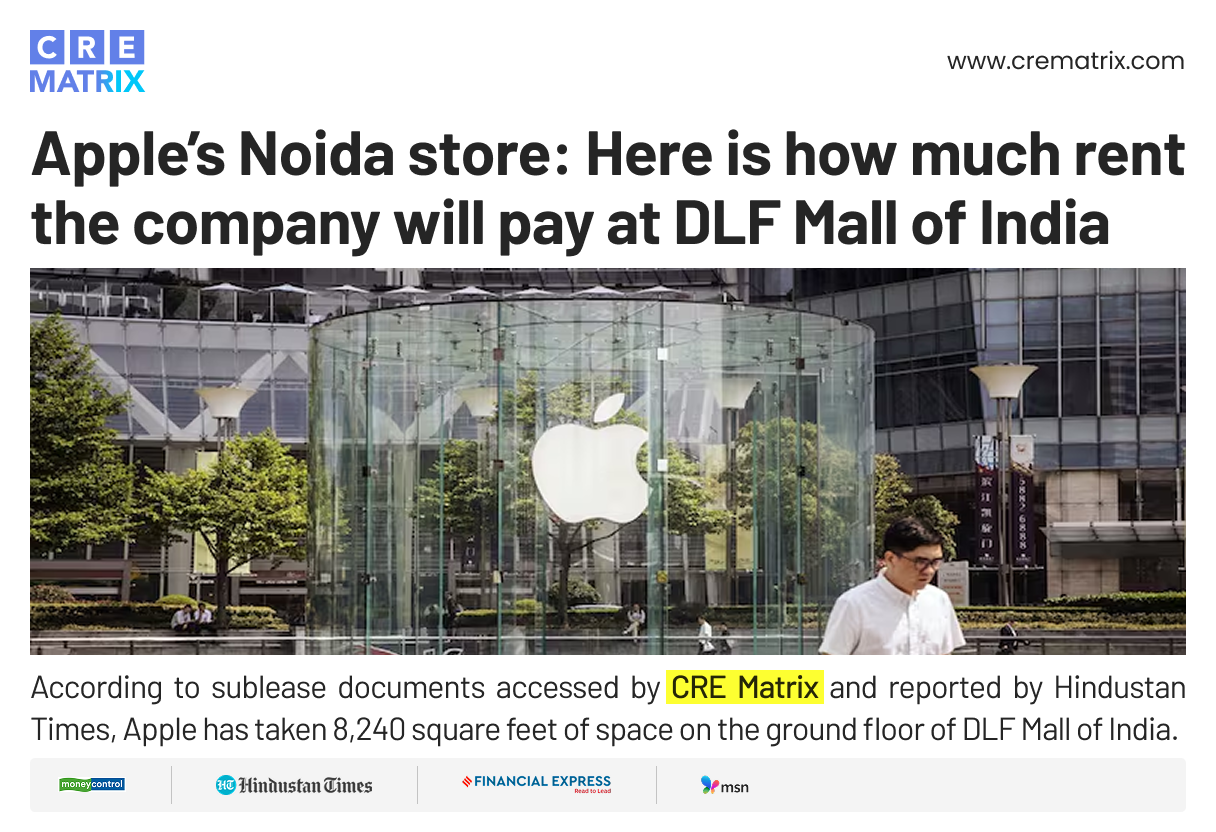
Apple is set to open its first retail store in Noida on December 11, marking the company’s fifth official Apple Store in India and its second in the Delhi NCR region after Saket. The new outlet is located at DLF Mall of India, one of the country’s largest and most prominent shopping destinations.

According to sublease documents accessed by CRE Matrix, Apple India Private Ltd has leased 8,240.78 sq ft of retail space at the mall for 11 years. The total rental outgo over the full tenure stands at approximately ₹65 crore, reflecting a long-term commitment to the market.

Lease Details

The documents show that Apple has leased six ground-floor retail units at DLF Mall of India, together comprising 8,240.78 sq ft of carpet area. The agreed rental stands at ₹263.15 per sq ft per month. This translates to a monthly rent of around ₹45.3 lakh and an annual rent of about ₹5.4 crore.

Additionally, the lease includes a one-year rent-free period. It also features a 15% rent escalation every three years. Over the full 11-year tenure, the total rent aggregates to ₹64.9 crore. Apple India Private Ltd and Paliwal Real Estate Limited signed the sublease deed on February 25, 2025.

Meanwhile, queries have been sent to Apple India, DLF, and Paliwal Real Estate Limited. The story will be updated if responses are received.

Strengthening Apple’s NCR Presence

With this launch, Apple strengthens its footprint in the Delhi NCR region. The Noida outlet follows the Saket store that opened in 2023. Retail experts say the move signals Apple’s growing confidence in Noida as a high-consumption and high-growth market.

Although rents for smaller stores at DLF Mall of India typically range between ₹500 and ₹700 per sq ft, larger-format stores enjoy pricing advantages. Due to scale and negotiation leverage, brands like Apple secure lower effective rentals. Experts also note that Apple’s Noida rent aligns closely with its Saket store, reinforcing consistency in its leasing approach.

Location Advantage and Catchment

DLF Mall of India spans nearly one million sq ft, making it Noida’s largest mall. It is also more than twice the size of Select Citywalk, Saket. Importantly, it remains the only retail centre of this scale and category in the region.

As a result, the Noida store benefits from a wide regional catchment. This includes Ghaziabad, Greater Noida, South Delhi, Agra, Mathura, and several emerging demand hubs.

Brand Pull Reflected in Leasing Strategy

According to industry observers, Apple’s rental levels reflect more than just location quality. They also highlight the strong footfalls and brand value that Apple brings to large-format malls. In turn, the Noida lease enhances DLF Mall of India’s position as a marquee retail destination in North India.

Overall, with the Noida opening, Apple continues its measured and data-driven retail expansion in India. The strategy balances prime locations, uniform store formats, and long-term lease commitments across key urban markets.

Elevate your decisions in real estate as a developer or broker with CRE Matrix‘s data-driven insights. Book a demo now!

WeWork Leases 1.76 Lakh Sq Ft at Skyview 20 in Hyderabad, Sub-Leases Entire Space to JP Morgan

WeWork Leases 1.76 Lakh Sq Ft at Skyview 20

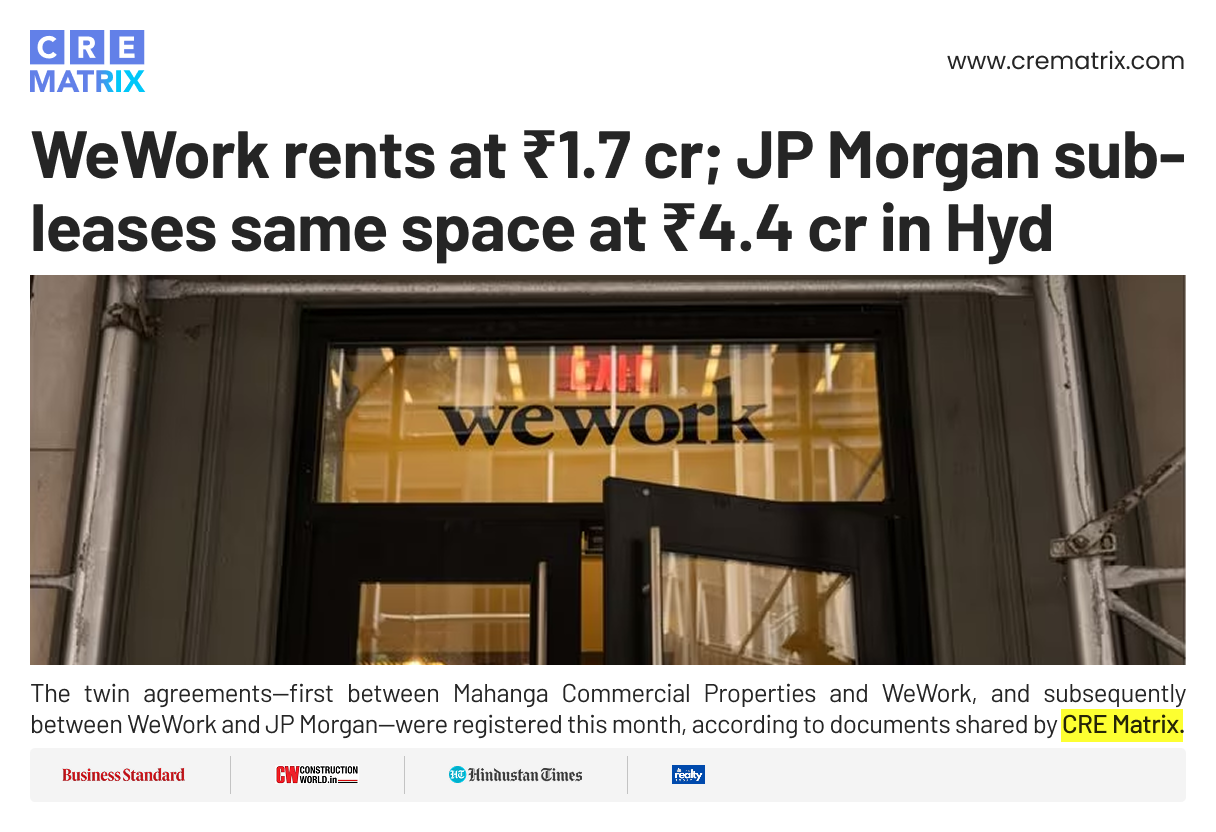
In one of Hyderabad’s biggest office deals this year, WeWork India has leased 1,75,953 sq ft at Skyview 20 in Hitech City, Madhapur. The space was immediately sub-leased to JP Morgan Services India Pvt Ltd, as confirmed by documents accessed by CRE Matrix.

The master lease between Mahanga Commercial Properties and WeWork, and the sub-lease between WeWork and JP Morgan, were both registered in November 2025. The back-to-back execution highlights the rapid uptake of premium offices in Hyderabad’s technology corridor.

WeWork has taken the space on a 60-month lease with a starting monthly rent of ₹1.72 crore. The security deposit is ₹10.34 crore. The area covers two floors—501 and 601 and includes 176 parking slots. The handover was done on 1 July 2025, followed by a four-month fit-out and rent-free period. With rent fixed at ₹98 per sq ft, the deal signals WeWork’s strong push into the Hyderabad market. It also reflects the city’s rapidly growing demand for flexible workspaces.

On 13 November 2025, WeWork sub-leased the entire area to JP Morgan at a significantly higher monthly rent of ₹4.38 crore. The agreement comes with a security deposit of ₹25.97 crore. JP Morgan will occupy the same floors, fitted with 1,501 desks as part of a managed office solution. The sub-lease runs for 60 months with a 24-month lock-in and a 5 percent annual rent escalation. Fit-out charges were set at ₹3,540 per sq ft, and the handover was done on 15 November 2025.

The sharp rent spread from ₹98 per sq ft in WeWork’s lease to ₹249 per sq ft in JP Morgan’s sub-lease shows the premium commanded by fully built, high-quality managed offices. It also highlights how global firms are increasingly opting for ready-to-move, service-backed workspaces over traditional bare-shell leases.

Skyview 20, located along Hitech City Main Road, remains one of Hyderabad’s most sought-after Grade-A office destinations. Its strong connectivity, modern infrastructure, and proximity to major IT hubs continue to draw multinational banks, tech companies, and enterprise occupiers. Additionally, the WeWork–JP Morgan deal further elevates its position as a top-tier commercial asset in the city.

Elevate your decisions in real estate as a developer or broker with CRE Matrix‘s data-driven insights. Book a demo now!

4 steps to follow to score a great commercial real estate deal

Investing in commercial real estate can prove to be more beneficial when compared to residential properties. Commercial property owners enjoy the extra cash flow, the valuable economies of scale, the comparatively open playing field, the abundant market for good, reasonably-priced property managers, and the chance for a possibly larger payoff from commercial real estate.

Commercial Deal

But how do you assess the best properties? And how do the great deals differ from the duds?

Understand What the Insiders Know

To be a participant in commercial real estate, learn to think like a professional. For instance, understand that commercial property is estimated differently when compared to residential property. Income generated on commercial real estate is directly linked to its usable square footage. That’s not the case when it comes to individual houses. When it comes to real estate investment, commercial properties offer a bigger cash flow. Moreover, commercial property leases are longer when compared to single-family residences. This generally paves the way for larger cash flow.

Learn to Detect a Good Deal 

The leading real estate experts recognize a great deal when they see one. How do they do that? First, they come up with an exit strategy. The finest deals are the ones you know you can move away from. It helps to have the eye of the landowner – always be on the lookout for damage that needs repairs, understand how to evaluate risk and make sure you get the calculator out to guarantee that the property meets your financial objectives.

Chart a plan of Action 

One of the primary parameters of real estate investment of commercial properties is to ask yourself how much can you afford to pay and then shop around for mortgages to get an idea of how much you will pay over the life of the mortgage. Using tools such as mortgage calculators can assist you in coming up with great estimates of the sum cost of your home.

Seek Motivated Sellers

Just like any business, customers are majorly responsible for the growth of real estate. Your job is to seek them, specifically those, who are ready and willing to sell below the market value. The fact is nothing happens until you get a deal, which is generally accompanied by a motivated seller. This is someone with a strong reason to sell below the market value. If your seller isn’t motivated enough, they won’t be ready to negotiate.

Use a Three-Pronged Method to Asses Properties 

You need to be adaptable when looking for good deals for real estate investment. Scour on the internet, read the classified ads, and hire experts to seek the best properties. Agents can assist you in seeking lucrative real estate investment in exchange for a referral fee.In a nutshell, these are some of the steps to follow to score a great real estate investment. Head over to CRE Matrix to look for great deals in the commercial real estate sector in India.

How to Avoid Signing a Bad Commercial Deal?

When you sign a commercial lease, it is a big step for your business. It is a new opportunity that can help drive your company to a new level. If the process goes well, you’ll have commercial space that saves your capital, accommodates your growth, matches your brands, and much more. However, if you sign a bad commercial lease, you could end up shelling more than required; acquire a bad space, or both for many years.

Commercial Buildings

Fortunately, the mistakes that result in bad commercial real estate decisions can be easy to avert, though. If you follow the below-mentioned steps, you can shield your business and set yourself to sign a great commercial property for lease.

Before you even begin to think about zeroing in on a specific building or a particular commercial space, you need to take a step back and conduct thorough research. You need to find out:

  • What do you require?
  • What you are willing to spend?
  • Where do you wish to be?
  • Where do you see your business progressing?

To do this, you will need to take a look at what you’re already doing in your current offices or other commercial spaces. Then, gather all the stakeholders together to comprehend their present as well as future requirements. Once you have completed your research, you will be ready to proceed to the subsequent part of the process.

Here are a couple of things to keep in mind to avoid signing a bad commercial lease:

Thoroughly Go Through the Details of Your Lease:

It’s extremely important to read the details of your commercial lease agreement prior to signing it. It is standard advice but is regularly ignored. Before you zero in on any commercial property for lease, it is vital to read your lease thoroughly as leases are complicated lease documents that can impact economics if a single word is misinterpreted.

Evaluate All Expenses

Signing a commercial property for lease shows you a whole array of different expenditures. Your rent and any proposed raise over the life of your lease are most probably significant, but they are the only expenses you will be paying. Pay close attention to the operating expenses of the building and how you will be accountable for them. If you can, try to get a gist of how the building is managed. If repair and maintenance expenses are less, it could signify greater expenses in the future as deferred maintenance causes more than regular repair bills.

Pay Close Attention to the End of the Lease Tenure 

Before you select the commercial property for lease, you need to keep certain parameters in mind. One of them is the end of your lease. The ending of the commercial lease is as significant as the beginning. When your lease expires, you will either wish to leave the office space or continue with it. It’s much easier to prepare for both possible outcomes at the start as opposed to start planning when the end is right around the corner. The key to continuing in the same space is to have renewal options drafted into your initial commercial lease agreement.

In a nutshell, the above-mentioned are some of the factors that you need to take into account before you get a commercial property for lease. In this way, you will be able to avoid signing a bad commercial lease that will prove to be disadvantageous for you.

Head over to CRE Matrix to view various commercial leases across industries in India to understand real estate better.

What are the Difficulties Faced while Obtaining a Commercial Lease?

The commercial real estate sector in India has developed and grown by leaps and bounds, particularly after the pandemic. Just like any other industry, the real estate sector was also impacted by Covid-19. But the sector slowly but surely bounced back. This has led to many more commercial properties that are taken on lease.

What is a Commercial Lease?

commercial lease is referred to as a contract between two parties in which one party (the landlord) permits another party (the tenant) to exclusively use the plot or building or office space for a specific duration (the term) in exchange for rent or a premium.

If the lease is not properly handled, then it will result in years of disagreements, lawsuits, and extravagant expenses. When you take the viewpoint of the landlord, if the lease is not properly drafted, it can lead to a number of issues.

This is why you need to be careful before taking a commercial property for lease. Here are a couple of areas that you need to pay attention to while obtaining the commercial lease:

Space:

Prior to taking a commercial property for lease, it is vital to find out how much room is included in the rental. It is also important to clarify whether your rental expenditure was computed using rental square footage or available square footage. Since common areas including toilers, hallways, elevators and lobbies are not part of the usable square footage, it is usually less than the rental square footage.

Lease: 

The period of a commercial lease is generally referred to as its ‘term’. It dictates the beginning and end dates of the lease contract, as well as whether or not there are specific renewal options. When it comes to longer lease terms, landlords are generally more flexible in negotiating leases but it is vital to keep the company’s requirements in mind as a longer lease generally means less flexibility in adapting to change as the company grows.

Termination 

If you’re taking a commercial property on lease, you need to be aware of all the procedures that come with terminating a commercial lease early as well as the conditions for ending a lease before the automatic renewal takes place. If the lease does not state a right to cancel, do consider securing a right to end the lease early in exchange for the payment of a fixed sum of liquidated damages to the landlord as a means to get out of the contract.

Security

When you take a commercial property on lease, you need to make sure that it’s obvious what can be subtracted from the security deposit and what can’t. Although laws prevent specific acts involving security deposits, you need to ensure that the commercial lease lays out the expectations and conditions for its return.

In a nutshell, these are some of the factors that you need to pay attention to before taking a commercial property on lease.

Head over to CRE Matrix to get insights on various commercial leases from across different sectors in India.

A Comprehensive Guide on Investing in Commercial Real Estate

An individual needs to undertake a massive amount of financial commitment brimming with uncertainty to clear the path for investing in CRE. Therefore, investing in commercial real estate must be made only after carefully considering all the risks involved. Commercial real estate investments are more complex when compared to residential investments because the taxes, regulations and taxes that are generally imposed on commercial real estate property are considerably more rigid when compared to residential properties.

Real Estate investment

What is Commercial Real Estate?

Properties that are generally used for economic or business activities are generally referred to as ‘commercial real estate’. CRE is extremely diverse and extensive, comprising everything from a single store to spacious multi-level shopping malls.

Hotels, hospitals, shopping centres, dining establishments, and office buildings are all examples that would come under commercial real estate.

To learn more about commercial real estate, you have to consider the following points:

  • Investors can make use of REITs (Public Traded Real Estate Investments Trusts) as a means to make indirect investments in commercial properties
  • Commercial property investment requires a bigger financial outlay as compared to purchasing a house. There is a stronger potential for gain as well as a bigger potential for loss in this industry.
  • Prospective rental income and capital appreciation are lucrative features of investing in commercial real estate.

As the name suggests, commercial real estate is the kind of property that is put to economic use.

How to Manage a Commercial Property?

Commercial real estate with tenants needs ongoing management on behalf of the property owner’s part. Thereby, a commercial property management firm can prove to be beneficial for property owners who require help with acquisition and retention, lease & financial administration, and marketing and upkeep planning. Managing office buildings, industrial complexes, and retail properties is a challenging balancing act that involves an abundance of information, transactional details, and results, thereby making the skillset of a commercial real estate management business priceless.

How to Make Money with Commercial Investment?

One way to guard your portfolio from the ups and downs of the stock market is to buy commercial real estate. By investing in commercial real estate, you can profit from the sale of their properties and the rents they gather from tenants.

Commercial buildings, like stores, have bigger returns on investment. Thereby, investors may wish to explore buying them (ROI). Ownership of the shop also lets the investor establish their own business, if not instantly, then at some point in the future.

Advantages of Investing in Commercial Real Estate

Here are a couple of advantages to investing in commercial real estate:

Security: Income generated from investing in commercial real estate is generally rather high. Relatively, residential rental yields are only approximately 1-2% of the property value of roughly about a third of the income CRE properties offer (9-12%).

Uniformity: Having a foolproof business plan increases the chances that CRE renters will pay on time.

Beneficial for Longer Tenure Commitments: Leasing a commercial property generally has a longer term, usually from one to two decades. Those who are investing in commercial real estate may rest assured that their income will be dependable and consistent thanks to it.

Relative Cost of Purchase: As opposed to residential residences, the long-term returns when investing in commercial real estate are far bigger. Additionally, investing in pricey real estate via financial ownership or REITs (Real Estate Investment Trusts) can yield strong returns on modest outlays of capital.

In a nutshell, investing in commercial real estate can prove to be hugely beneficial in India. If you wish to see additional insights on real estate and where to invest, then head over to CRE Matrix.

5 Mistakes to Avoid when Signing a Commercial Lease

Covid-19 disrupted many businesses across the country. But slowly but surely they have bounced back. The real estate sector in India is no different, particularly the commercial real estate industry. Nowadays, more and more businesses are seeking commercial property to lease. But there are some mistakes that companies need to avoid before they sign on to the dotted line.

Signing a Commercial Lease

Let’s take a look at some of the errors firms can avert before they sign a commercial lease:

Location:

Every business requires something from its location. For a few, it’s access to the highway. A couple of others would require public transport. Some depend on passing foot traffic while a few would opt for an exclusive customer base. Whatever you’re necessities are the location needs to back them up. Even the most preferred lease can’t compensate for a location n that simply does not have what your business would require to succeed. This is one of the most important mistakes to avoid before renting a commercial property

Misunderstanding the Physical Space 

With the rising popularity of flextime, remote as well and hybrid-workspace setups, it’s not always easy to understand how much space your business would need. To make things even more challenging, the breakdown of commercial rental spaces is not always consistent either. This is one of the errors to avert before signing a commercial lease

Not Considering All the Expenses

Usually, rent and fit-outs are typically the main expenditures, commercial tenants may consider, but they are not the only property-related expenses. Before leasing a commercial property, you need to check whether your business will be accountable for things such as rates and utilities or repairs and maintenance, or if those fall under the duties of the landlord. Moreover, you need to ensure that any rental escalation clauses in the leases are affordable and market-related. A good deal does not ensure a great deal in the future. 

Undervaluing the Significance of Flexibility 

It is vital to be as flexible as possible with your commercial lease. Shorter lease terms are generally less risky, thereby providing you an earlier out if your circumstances no longer remain the same. If you do choose a longer lease term, usually available, at a more preferred rate, ensure that there is a fair breakaway clause with a more realistic termination process and no unreasonable cancellation penalties. 

Not Negotiating 

commercial lease is not a standard document. This usually means that anything is usually up for negotiation. Commercial landlords and their representatives are real estate professionals who are aware of how to handle negotiations to achieve the results they want. Tenants are in a powerful position and are obtaining the deals they want when they use the correct strategy, especially when they are backed by skilled commercial property professionals. 

In a nutshell, the above-mentioned mistakes need to be avoided before signing a commercial lease. 

Head over to CRE Matrix to get real estate insights on any commercial property in India. 

What are the Top 10 Cities in India for Property Investment?

Investing in real estate is one of the most important financial commitments you can make, and if you do it correctly, it can alter you entire life. Real estate investment in India can have its benefits as well as downfalls. Making the right choice can enable you to achieve your goals, while making the wrong choice make your finances as well as other issues worse. This is why, you need to be informed when you decide to pick the correct option and amplify the rewards of your investment.

Property Investment in India

It’s difficult to pin point which of the top 20 cities in India are good for real estate investment, as it can depend on numerous factors including current market conditions, infrastructure development, and government policies. Parameters that are taken into consideration when deciding the top cities for real estate investment in India comprise of include the strength of the local economy, population growth, and the steadiness of the real estate market, among many others.

Moreover, factors relating to proximity to amenities and transportation, local zoning laws as well as the availability of financing can also play a significant role in deciding whether a particular city is a good place to invest in property. However, a couple of the cities that is typically worthy options for real estate investment in India are:

Mumbai: Dubbed as the financial capital of India, Mumbai has a powerful economy and a flourishing real estate market.

Delhi: As the capital city of India, it has a large population and a developing economy, thereby making it a famous destination for real estate investment in India.

Bengaluru: It is the IT capital of India. Bengaluru has a huge amount of job opportunities and a large population, thereby making it a great destination for real estate investment in India.

Pune: Renowned for its pleasant climate and proximity to the IT hub of Hinjewadi, Pune has emerged as a lucrative destination for property investment in the last couple of years.

Kolkata: It is the commercial as well as cultural capital of Eastern India. Kolkata is an incredible place if you’re looking for properties at budget-friendly rates.

Hyderabad: Renowned for its IT and biotechnology industries, Hyderabad has a developing economy and a huge number of job opportunities, thereby making it a great place for real estate investment in India.

Chennai: Known as a major industrial and cultural center, Chennai has a fast-growing economy and abundant job opportunities. This is why it would make for a good destination for real estate investment.

Ahmedabad: It is the largest city of Gujarat and is known for its abundant job opportunities. This makes it an excellent place for property investment.

Surat: Famed for its textile industries, Surat has a strong growing economy and a plethora of job opportunities. This makes it an incredible destination for real estate investment in India.

Jaipur: The pink city is known for its strong economy and a large number of job opportunities, particularly in the tourism sector, thanks to its heritage. This makes it a great destination for investment in property.

In a nutshell, these are top 10 cities that are excellent for real estate investment in India. If you wish to get real estate insights on a pan-India basis, then head over to CRE Matrix, a leading real estate data analytics company in India.

Commercial Leasing Due Diligence Guide: How to Acquire the Best Deal?

When it comes to commercial real estate in India, the process of comprehending the property, the terms of the lease, as well as the way your tenancy will work, is referred to as due diligence. It needs you to do your homework as well as pay attention to the physical, financial as well as legal aspects of the lease. 

If you don’t perform due diligence before leasing a property, business owners end up signing a lease that disrupts their business operations. For example, a few landlords are dishonest and showcase no fair dealings when leasing a property. The majority of landlords lease out properties that are in the process of foreclosure, and a few have bad relationships with their present tenants. Due diligence aids potential commercial real estate tenants to avoid needless conflicts and challenges when they shift to their new office space. 

Additionally, due diligence aids tenants to know as much about the property they wish to lease as the landlord. This assists them to be a beneficial point when negotiating with the property owner. Moreover, while performing due diligence, business owners can find data they can utilize while negotiating reasonable deals. 

Commercial Leasing Due Diligence Tips 

Be on the Lookout for Hidden Expenses 

Sometimes, a commercial lease will make tenants pay for the maintenance expenses. Thereby, it is important that you know all the essentials of the ‘gross lease’, so you’re aware of the expenses that you are accountable for. This will assist you to negotiate and also drop the ones that do not fulfil your business requirements. 

Assess the Terms of the Lease Agreement 

You must be aware of the terms of the commercial lease agreement, particularly regarding default and termination of the lease. The knowledge of the termination clause will assist in negotiating a fair penalty for lease termination before it expires.

Evaluate your Potential Future Development 

To avoid paying for extra spaces that you may never utilize, you need to carefully check your capacity for future development. It’s important to not be extra ambitious, as this can lead to having space that may never get occupied. This is one of the major factors to keep in mind before you sign a commercial lease

Research Market Rates 

Acquire an idea of market rents in the region where you are considering and compare them to whatever price the landlord is asking for the rent. It is also vital to point out that just because you have lived in the same place as the new property does not mean the new rental rate will be in the same bracket. 

Thereby, it is important that you thoroughly research the market rates and comprehend what the present trends are. Before signing the commercial lease and making a payment, you must get an idea of the average market rental in the region. This can assist in negotiating a lower price if your landlord is demanding a higher rate. When researching the market rates, you can spend some time interacting with a broker who will provide you with updated details on the market lease rates. 

In a nutshell, above are some of the due diligence tips to keep in mind before you sign a commercial lease for office space. If you wish to have more insights on commercial leasing, then do subscribe to CRE Matrix

4 Facts You Need to Know About Security Deposit in India?

When leasing a commercial property, the tenant is required to pay a specific amount of money upfront before moving into the space. But many are not fully aware of the facts connected to it such as how much money has to be paid as a security deposit and what vital elements that need to be included in the security deposit clause of the lease agreement. Once you’re aware of these pointers, you can go ahead and sign the lease. 

What is Security Deposit?

Security deposit in India is a significant amount paid by the tenant to the landlord at the time of moving into the leased property. It is held all through the tenure of the lease and paid back once the lease is over. This money is important for the landlord as the amount is kept aside for unforeseen conditions that may come up during the tenancy. For example, if the tenant does not adhere to the contract and damages the property or does not pay rent, then the landlord can utilize the security deposit for repairs or rental compensation.

Let’s take a look at 4 vital facts about security deposits you need to know before you sign the lease for commercial property:

Security Deposit Amount Varies in India

The security deposit for a lease that is required before moving into a commercial property varies across different states in India. In major cities, the landlord charges a security deposit as per the cost of living, the type of area, and the locality. The higher the property’s value, the higher the lease as well as the security deposit.

The income level in cosmopolitan cities also plays a role in the monthly rental as well as the security deposit. For instance, the security deposit required by landlords is up to 10 months or 1 year’s rent in Bengaluru.

Awareness of Laws Surrounding Refund of Security Deposits 

According to the Model Tenancy Act, it allows the tenant to reduce rent arrears and other repair charges from the security deposit and refunds the remaining deposit when the tenure of the lease ends, and the tenant leaves the premises. So it’s important to be aware of all the laws surrounding security deposit for commercial property before you sign the lease.

Reasons for Losing Security Deposit

In certain cases, you don’t get your security deposit back. Some of the main reasons why a landlord will not return your security deposit are when there are damages that are done to the property when you have leased it. This includes tampered wall paint, broken tiles and floorings or damaged furniture, among many others.

What Happens if the Landlord Does Not Return the Security Deposit?

In such a scenario, the tenants are free to file a civil suit against the landlord, particularly if the security deposit is not refunded within the stipulated duration. Moreover, criminal charges of charges can also be filed against the landlord. Furthermore, a police complaint can be filed if the security deposit refund is denied.

In a nutshell, these are some of the facts about security deposit for commercial space in Mumbai.

CRE Matrix is a leading real estate data analytics company in India that showcases crucial details about security deposits as well as the leasing status of numerous companies across various sectors to stakeholders.

For more such exciting analysis and details on real estate, visit CRE Matrix.