
What are the Top 10 Cities in India for Property Investment?

Investing in real estate is one of the most important financial commitments you can make, and if you do it correctly, it can alter you entire life. Real estate investment in India can have its benefits as well as downfalls. Making the right choice can enable you to achieve your goals, while making the wrong choice make your finances as well as other issues worse. This is why, you need to be informed when you decide to pick the correct option and amplify the rewards of your investment.

Property Investment in India

It’s difficult to pin point which of the top 20 cities in India are good for real estate investment, as it can depend on numerous factors including current market conditions, infrastructure development, and government policies. Parameters that are taken into consideration when deciding the top cities for real estate investment in India comprise of include the strength of the local economy, population growth, and the steadiness of the real estate market, among many others.

Moreover, factors relating to proximity to amenities and transportation, local zoning laws as well as the availability of financing can also play a significant role in deciding whether a particular city is a good place to invest in property. However, a couple of the cities that is typically worthy options for real estate investment in India are:

Mumbai: Dubbed as the financial capital of India, Mumbai has a powerful economy and a flourishing real estate market.

Delhi: As the capital city of India, it has a large population and a developing economy, thereby making it a famous destination for real estate investment in India.

Bengaluru: It is the IT capital of India. Bengaluru has a huge amount of job opportunities and a large population, thereby making it a great destination for real estate investment in India.

Pune: Renowned for its pleasant climate and proximity to the IT hub of Hinjewadi, Pune has emerged as a lucrative destination for property investment in the last couple of years.

Kolkata: It is the commercial as well as cultural capital of Eastern India. Kolkata is an incredible place if you’re looking for properties at budget-friendly rates.

Hyderabad: Renowned for its IT and biotechnology industries, Hyderabad has a developing economy and a huge number of job opportunities, thereby making it a great place for real estate investment in India.

Chennai: Known as a major industrial and cultural center, Chennai has a fast-growing economy and abundant job opportunities. This is why it would make for a good destination for real estate investment.

Ahmedabad: It is the largest city of Gujarat and is known for its abundant job opportunities. This makes it an excellent place for property investment.

Surat: Famed for its textile industries, Surat has a strong growing economy and a plethora of job opportunities. This makes it an incredible destination for real estate investment in India.

Jaipur: The pink city is known for its strong economy and a large number of job opportunities, particularly in the tourism sector, thanks to its heritage. This makes it a great destination for investment in property.

In a nutshell, these are top 10 cities that are excellent for real estate investment in India. If you wish to get real estate insights on a pan-India basis, then head over to CRE Matrix, a leading real estate data analytics company in India.

Commercial Leasing Due Diligence Guide: How to Acquire the Best Deal?

When it comes to commercial real estate in India, the process of comprehending the property, the terms of the lease, as well as the way your tenancy will work, is referred to as due diligence. It needs you to do your homework as well as pay attention to the physical, financial as well as legal aspects of the lease. 

If you don’t perform due diligence before leasing a property, business owners end up signing a lease that disrupts their business operations. For example, a few landlords are dishonest and showcase no fair dealings when leasing a property. The majority of landlords lease out properties that are in the process of foreclosure, and a few have bad relationships with their present tenants. Due diligence aids potential commercial real estate tenants to avoid needless conflicts and challenges when they shift to their new office space. 

Additionally, due diligence aids tenants to know as much about the property they wish to lease as the landlord. This assists them to be a beneficial point when negotiating with the property owner. Moreover, while performing due diligence, business owners can find data they can utilize while negotiating reasonable deals. 

Commercial Leasing Due Diligence Tips 

Be on the Lookout for Hidden Expenses 

Sometimes, a commercial lease will make tenants pay for the maintenance expenses. Thereby, it is important that you know all the essentials of the ‘gross lease’, so you’re aware of the expenses that you are accountable for. This will assist you to negotiate and also drop the ones that do not fulfil your business requirements. 

Assess the Terms of the Lease Agreement 

You must be aware of the terms of the commercial lease agreement, particularly regarding default and termination of the lease. The knowledge of the termination clause will assist in negotiating a fair penalty for lease termination before it expires.

Evaluate your Potential Future Development 

To avoid paying for extra spaces that you may never utilize, you need to carefully check your capacity for future development. It’s important to not be extra ambitious, as this can lead to having space that may never get occupied. This is one of the major factors to keep in mind before you sign a commercial lease

Research Market Rates 

Acquire an idea of market rents in the region where you are considering and compare them to whatever price the landlord is asking for the rent. It is also vital to point out that just because you have lived in the same place as the new property does not mean the new rental rate will be in the same bracket. 

Thereby, it is important that you thoroughly research the market rates and comprehend what the present trends are. Before signing the commercial lease and making a payment, you must get an idea of the average market rental in the region. This can assist in negotiating a lower price if your landlord is demanding a higher rate. When researching the market rates, you can spend some time interacting with a broker who will provide you with updated details on the market lease rates. 

In a nutshell, above are some of the due diligence tips to keep in mind before you sign a commercial lease for office space. If you wish to have more insights on commercial leasing, then do subscribe to CRE Matrix

5 Ways in Which Data Analytics is Contributing to Real Estate Growth in India

Businesses across various industries in India are leveraging big data nowadays. Thanks to data analysis, businesses enjoy streamlined resources management, a rise in operational efficiencies, big development opportunities, accelerated and smart decision-making as well as improved product development among other benefits.

When it comes to the real estate sector, it is no different. More and more companies, investors, sellers as well as buyers are taking to data in a major way to create algorithm models and predictive analytics to eliminate the guesswork. As a result, they are coming up with more accurate predictions. Furthermore, these estimates provide numerous advantages to the stakeholders.

Here are 5 ways, data analytics is contributing to real estate growth in India:

Digitizing & Automating Real Estate Evaluation

Today, the biggest deal-breaker in the real estate sector would be the price. The present rate or the estimated price in the future of the property assists in determining if it will be the correct investment or not. With the help of real estate data analysis, models can be built using ML algorithms to assess the valuation of any property based on historically relevant details such as the age of the property, location and condition. It can deliver an evaluation within a few seconds for overall consideration.

Optimizing the Buyer-Selection Process

Real estate data analytics India can not only assist you to determine the worth of your property, but it also can aid you to seek the right people who are more likely to be interested in a particular property based on their preferences, location, budget and so forth. Data captured by the buyers can be used to recommend properties that cater to their requirements the most. Similarly, real-estate firms can acquire the information of the buyers who are the correct profile for their offerings, so they can invest the optimum amount of time and energy in potential buyers who are the most serious.

Evaluating & Observing Market Trends

Today, to continue a real-estate business, it is necessary to have the correct understanding of every feature that plays a key role in estimating a property’s value. With the increasing factors, it is very significant to keep up to date and understand all the moves your competitors are making. Data Analytics in India becomes very important in assessing and checking the market trends and comprehending the impact of other factors on real-estate expenditures.

Understanding Patterns to Expect Future Development:

Unlike retail, real estate does establish a specific pattern in its development that typically compliments the local trends, economic stability, demographics, government policies, provisions/subsidies around purchasing real estate, interest rates, and so forth. By making use of data analytics, all these together echo the correlation with the price and aid in uncovering the patterns that assist in estimating the future development of real estate.

Increasing Profits & Decreasing Overall Development Expenses:

Real-estate firms invest their money in land acquisition and then development. Data analytics provides visibility into the valuation of the land to make sure they purchase the land at an optimal rate and development cost can also be managed by tracing how much raw material is required to construct any building space by evaluating the historical data to reduce the wastage which leads to an optimized cost of development. Thanks to the help of data analytics, real-estate firms can predict the value of the property and can sell accordingly to ensure augmented returns on every sale.

CRE Matrix is a leading real estate data analytics company in India. They make use of data analytics to help stakeholders across different industries make well-informed business decisions.

For more such exciting analysis and details on real estate, visit CRE Matrix.

4 Facts You Need to Know About Security Deposit in India?

When leasing a commercial property, the tenant is required to pay a specific amount of money upfront before moving into the space. But many are not fully aware of the facts connected to it such as how much money has to be paid as a security deposit and what vital elements that need to be included in the security deposit clause of the lease agreement. Once you’re aware of these pointers, you can go ahead and sign the lease. 

What is Security Deposit?

Security deposit in India is a significant amount paid by the tenant to the landlord at the time of moving into the leased property. It is held all through the tenure of the lease and paid back once the lease is over. This money is important for the landlord as the amount is kept aside for unforeseen conditions that may come up during the tenancy. For example, if the tenant does not adhere to the contract and damages the property or does not pay rent, then the landlord can utilize the security deposit for repairs or rental compensation.

Let’s take a look at 4 vital facts about security deposits you need to know before you sign the lease for commercial property:

Security Deposit Amount Varies in India

The security deposit for a lease that is required before moving into a commercial property varies across different states in India. In major cities, the landlord charges a security deposit as per the cost of living, the type of area, and the locality. The higher the property’s value, the higher the lease as well as the security deposit.

The income level in cosmopolitan cities also plays a role in the monthly rental as well as the security deposit. For instance, the security deposit required by landlords is up to 10 months or 1 year’s rent in Bengaluru.

Awareness of Laws Surrounding Refund of Security Deposits 

According to the Model Tenancy Act, it allows the tenant to reduce rent arrears and other repair charges from the security deposit and refunds the remaining deposit when the tenure of the lease ends, and the tenant leaves the premises. So it’s important to be aware of all the laws surrounding security deposit for commercial property before you sign the lease.

Reasons for Losing Security Deposit

In certain cases, you don’t get your security deposit back. Some of the main reasons why a landlord will not return your security deposit are when there are damages that are done to the property when you have leased it. This includes tampered wall paint, broken tiles and floorings or damaged furniture, among many others.

What Happens if the Landlord Does Not Return the Security Deposit?

In such a scenario, the tenants are free to file a civil suit against the landlord, particularly if the security deposit is not refunded within the stipulated duration. Moreover, criminal charges of charges can also be filed against the landlord. Furthermore, a police complaint can be filed if the security deposit refund is denied.

In a nutshell, these are some of the facts about security deposit for commercial space in Mumbai.

CRE Matrix is a leading real estate data analytics company in India that showcases crucial details about security deposits as well as the leasing status of numerous companies across various sectors to stakeholders.

For more such exciting analysis and details on real estate, visit CRE Matrix.

How can CRE Leases Help Companies Keep Track of Leasing Trends?

The commercial real estate sector in India is huge. As more and more startups are emerging, it has increased a need for more and more office space. This has led to an increasing number of businesses taking up more commercial space for leasing. Considering how important leasing is for a business and the revenue it can generate, it is extremely vital for companies to keep track of leasing trends of various brands and organizations across industries.

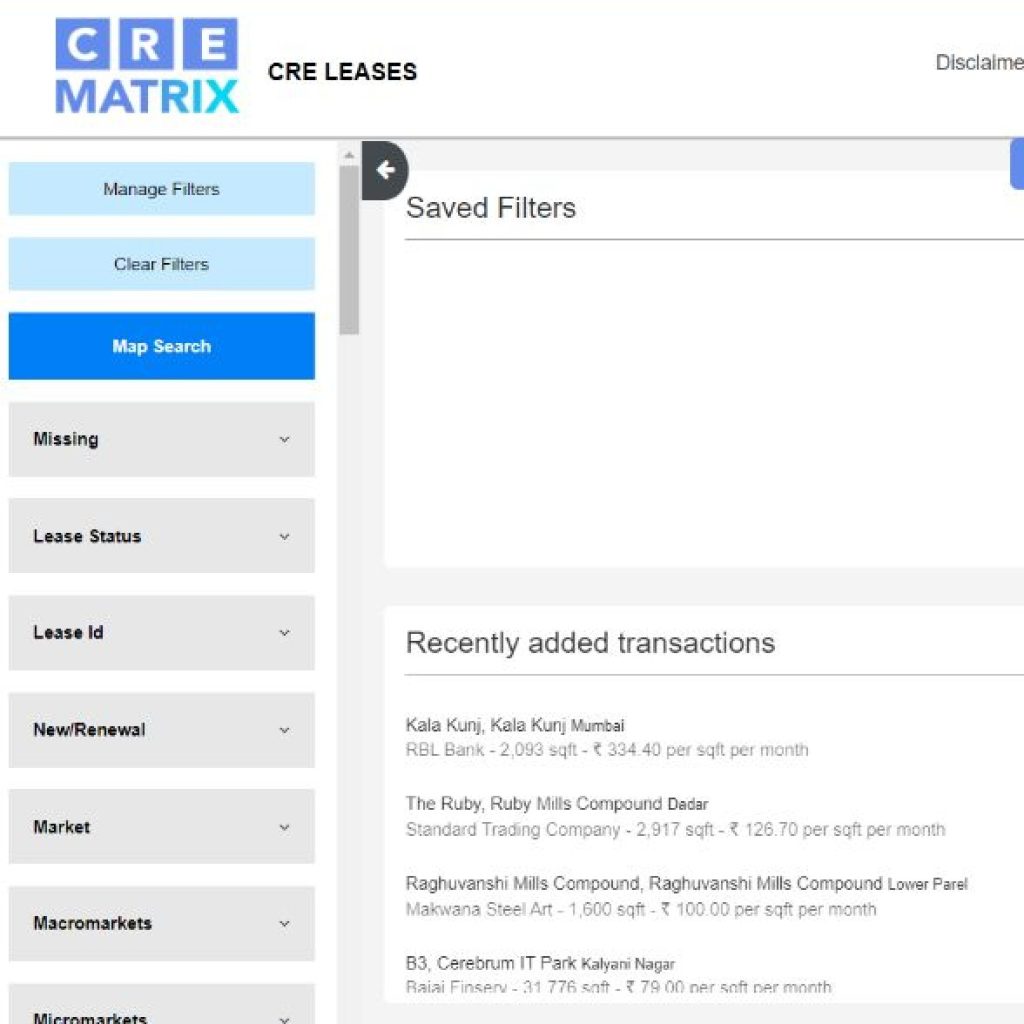
This is where a firm such as CRE Matrix can hugely benefit. It is a leading real estate data analytics company India that allows stakeholders from various industries to view and compare crucial lease-related data that can prove to be immensely useful for making informed decisions about their businesses. CRE Matrix offers various tools – for both commercial & residential. One of the platforms that companies can use to understand more about the leasing trends of the market and compare their performance with their competitors is CRE Leases.

Let’s talk a little bit about CRE Leases and how this tool can help businesses comprehend the newest leasing trends.

What are CRE Leases?

CRE Leases is a tool offered by CRE Matrix that can aid companies and brands to understand a little about the leasing trends in the market today in this country with respect to offices, warehouses, retail, and so forth.

How Do CRE Leases Work?

The client can seek leasing data from the number of filter buttons available. Some of the important ones are:

Lease Status: Here, you can select the status of your lease or the status of the lease you wish to view. The options that you can choose from are: active, inactive, active due to renewal, active as co-working and in-active as co-working.

MacroMarket: Once you have chosen the market, you need to select the macromarket. For e.g.: If you have selected Mumbai as your market, then the macromarket can be Central Suburbs, Western Suburbs etc.

MicroMarket: After you have chosen the market, you need to proceed to pick the micromarket. For e.g.: If you have chosen Mumbai as your market, then the micromarket can be Andheri (E) or Borivali (W).

Grade: Here you can choose the grade of the building. For e.g.: Grade A, B, C, shopping mall, 3 star, 5 star and so forth.

Area Leased: In this filter, you can select the range of the area that has been leased.

Tenant: You can choose the tenant whose details you wish to view.

Landlord: You can select the landlord whose information you wish to take a look at.

Agreement Type: Here, you can pick the kind of leasing agreement you have been seeking. For e.g.: Lease Deed, Leave and License, Transfer Deed and so forth.

Lock-In Period: In this filter, you can select the duration of the lock-in period.

Rent-Free Period: Here, you can choose the start and the end range of the rent-free period.

Security Deposit: You can select the range of the security deposit in this specific filter.

To sum up, the above-mentioned filters are just some of the many options available for you to get lease data of a number of companies across industries. There are many other filters available that can give you the complete picture of the information you’re seeking.

CRE Leases is a comprehensive and robust offering, powered by CRE Matrix, which allows you to compare crucial leasing data. Trends and patterns emerge from the vital information provided.

If you wish to be the recipient of significant lease information, do subscribe by visiting CRE Matrix.

5 Challenges Faced in Securing a Profitable Commercial Lease in India

As the world slowly bounces back after the pandemic, office space leasing in India reached an all-time high this year.

What is Commercial Lease? 

A commercial lease is an agreement between two parties in which the landlord permits the tenant to use their land or buildings exclusively for a particular duration (the tenure) in exchange for rent or a premium. 

Let’s look at some of the challenges companies face when trying to secure a profitable commercial lease India

Space

When looking at a commercial space in Mumbai, it’s important to determine how much room is encompassed in the rental. It is pertinent to clarify whether your rental expenditure was estimated using rental square footage or available square footage. If you have a good understanding of the space that makes up the rental, you will be able to determine whether the quoted rate is fair or not, and if needed, you will be able to negotiate well. 

Lease

The duration of the lease is referred to as its ‘term’. It talks about the commencement and end dates of the agreement, as well as whether or not there are any particular renewal options. It is extremely significant to keep the company’s requirements in mind when looking at a lease. A longer lease implies less flexibility in adjusting to change as the company grows. Moreover, if the market price of the rent drops, accepting a long lease period in advance could lead to the company paying above the market rent for the leased space. 

Dispute Resolution 

When you’re looking to lease an office space Powai, it’s important to pay attention to the terms of the contract, particularly for any dispute resolution. Expenses of litigation can easily exceed those for a small business with fewer resources. 

Legal Compliance 

Commercial spaces in India are generally subject to a horde of laws and regulations. Usually, a landlord is considered to be in charge of making sure that the entire property is in adherence with the law. But it’s vital to understand the expectations for any individual leased space. You need to ask the landlord to explain in detail the conditions of the lease if it’s not clear who is tasked with ensuring compliance with pertinent laws. 

Termination 

Any commercial tenant needs to be fully aware of all the procedures involved in terminating a lease early as well as the stipulations that come with ending a lease before any renewal. If the lease does not address any right to cancel, it might be wise to secure a right to end it early in exchange for the payment of a specified amount of liquidated damages to the landlord to give yourself an out. 

In a nutshell, these are some of the challenges that need to be addressed before securing a profitable commercial lease in India. 

CRE Matrix is a leading real estate data analytics firm in India. It gives access to several companies where you can take a look at the status and minute details of numerous commercial leases in the country. 

For more such exciting analysis and details on real estate, visit CRE Matrix.

3 Reasons Why Startups are Leading the Demand in Increased Office Space in India

In India, the startup culture has been around for decades but has witnessed massive growth in the last decade. According to the joint study ‘Startups Scale Up’ by CRE Matrix and Colliers India, startups in this country have generated 6.6 lakh direct jobs and 34 lakh indirect jobs in the last decade. Overall, the startup landscape is growing with more depth and has bigger corporate participation. 

From the perspective of the commercial real estate sector India, startups have slowly but surely become a major force to be reckoned with. As per the reportStartups in India have demonstrated the demand for increased office space in 2021. The rise in office space from startups is only witnessing more traction in metro cities but also in non-metro cities as well. 

Let’s look at some of the reasons why startups are leading the demand in increased office space in India:

Key Government Incentives for Startups 

As per the report

  • The government has allotted 10,000 crore INR to provide capital to startups, via funds of funds scheme. 
  • 283 crore INR has been allocated to Startup India Seed Fund Scheme (SISFS)
  • Income Tax is waived for about three out of ten years from the date of incorporation 
  • Extra focus on digitization and fintech in budget 2022 can drive a boost to startups. 
  • Emergency Credit Line Guarantee Scheme (ECLCS) is applicable till March 2023. Under this policy, emergency loan facilities are to be delivered to businesses that have been afflicted during the pandemic. 

Preference for Collaborative Work Environment 

Startups have demonstrated a preference for collaborative and flexible work culture. A friendly, collaborative and creative workspace is usually believed to be the norm in a young startup’s (1-3 years) culture. Generally, there is a high preference for fully-managed commercial space India and flex spaces owing to lower capex and flexible lease terms. 

As startups become more prevalent and expand their services, their reach has also increased, leading to preferring quality Grade A buildings with enhanced wellness standards. A preference for a collaborative, flexible and hospitable work environment is one of the factors contributing to the popularity of startups that has led to the rise in the demand for office space. 

Pandemic Led to Increased Demand for Office Space 

COVID-19 witnessed reverse migration, with more and more people returning to their hometowns. This led to more opportunities for newer startups to emerge and step up as well as the chance to solve local challenges. Availability of talent, stronger & deeper internet reach and lower cost of living has made a powerful case for non-metro cities. According to the report, approximately, 40% of the new startups that were launched in 2021 were observed from non-metro cities. This suggests the rise in popularity of startups in non-metro cities. 

In a nutshell, these are some of the reasons why startups have been leading the demand for increased office space in the commercial real estate sector India

Visit CRE Matrix, a prominent real estate data analytics company in India that offers various tools and resources to check crucial real estate data with regard to companies and brands across industries. 

For more such exciting analysis and details on real estate, visit CRE Matrix.


3 Factors to Consider While Leasing Commercial Property in India

Before you negotiate a commercial lease, it is essential to assess your business requirements. Moreover, it is also crucial to decide your budget and preferred location. 

What is a commercial lease? It is one of the most significant elements required for a business to thrive and prosper. Since rent remains an important hidden expense, it is vital to negotiate a decent commercial contract that drives your business development in the long term. 

A well-negotiated commercial lease will enable you to avert any issues or at least put you in a fantastic position. In general, any kind of investment in real estate is dicey. This kind of investment in commercial real estate needs to be conducted with thorough research and study to avert any foul game. 

Here are a couple of factors that need to be kept in mind while leasing commercial property India

Conduct a Thorough Research 

It is extremely vital to conduct thorough research before finalizing the location. Be sure to take a look at as many properties as you can, and be open to exploring multiple premises. The correct space in your business can be a make-or-ruin scenario so you want to make sure you take as much time as possible to conduct it effectively. 

Don’t compromise for a lesser-quality building. Moreover, it is extremely significant to choose a commercial property in India to lease where there are numerous major landmarks, and obviously, where your customers can connect with you easily. 

Period of Lease

Before you commit to leasing commercial space Mumbai, you must take care to find out the period of the lease you require. When you begin a business, it’s tough to estimate how it will perform. With a long-term business, however, you can commit to a 5-year lease settlement as you’ve got the price range to pay for the lease. You don’t want to get stuck in a long-time lease when you’re commercial business isn’t always dependable. A brief lease comes with its own benefits as you can move to another facility when you feel your business requires it. 

Review the Lease Agreement 

It is extremely vital to review your leasing contract before you commit to leasing office space in India. Your task as a prospective tenant is to review the lease agreement completely and request changes that will be suitable for your business. 

It is critical for both the tenant and the landlord to clearly describe the location and the accurate square footage of the premises. The tenant needs to also make sure that the landlord has the legal authority to enforce the lease, and has all the important documents in place, including the registration certificates and property tax receipts. One must take extra precautions to make sure that there is no ambiguity in this respect. 

In a nutshell, these are some of the parameters that you need to keep in mind before signing a lease for office space in the commercial real estate sector in India

CRE Matrix is India’s leading real estate data analytics company in India, which can provide you with critical lease-related details about various firms across industries that can help you make informed decisions about your business. 

For more such exciting analysis and details on real estate, visit CRE Matrix.

Key Differences between Lease & Rent: What Should You Opt For?

How many of us were aware that leasing and renting is not exactly the same thing? Thanks to their many similarities, it’s easy to assume that both the terms are one and the same. Until you enter into a leasing or rental agreement India, you will not be able to spot the subtle differences between the two concepts. Even though the two words are frequently used interchangeably, leasing a commercial space is not the same as renting it. 

In this blog article, we aim to educate on some of the key differences between a ‘lease’ and ‘rent’. 

Lease vs. Rent 

A rent contract, a document signed between the tenant and the landlord to make the renting process official, can either be a lease or a license. Whether a tenancy could be carried out via a license or a lease agreement is fundamentally decided by the tenure of the tenancy. 

Under the lease, the landlord is required to transfer the right to make use of the property, to the tenant for a specific period of time in return for the rent. Leasing is typically observed more in the commercial real estate space sector in India. On the other hand, a rental agreement India is regarded as a legal contract where the landlords give their property to a tenant for residential/commercial use for a shorter period. 

Key Differences between Lease & Rent

Here are a couple of differences between leasing and renting based on the following factors:

Parties Involved: When you enter into a lease contract India, the parties involved are referred to as lessor and lessee, whereas in a rental agreement, the relevant parties are known as a landlord and tenant. 

Time Span: A lease is generally agreed upon for a longer duration, i.e. 6-12 months or more as decided by both the parties. On the other hand, rent is for a shorter time frame, i.e. on a monthly basis or it can be up to 11 months. 

Repair Expenditures: The monetary expense for maintenance and repairs has to be borne by the lessee whereas when it comes to a rental agreement, the tenants need to pay for this expenditure. 

Terms & Conditions: In a leasing contract, the terms and conditions cannot be altered once they have been signed and agreed upon by both parties. Nevertheless, if both the lessee and lessor decide to revise some portion of the agreement they will have to get into a lease amending the contract. On the other hand, landlords can modify the terms in a rental agreement arrangement by giving a head’s up to the tenant. 

To sum up, these are four key differences between leasing and renting a residential or office space in India. You can use CRE Matrix – a leading real estate data analytics firm in India – to give you a detailed breakdown of the leasing and rental status of numerous brands/companies across the country. 

For more such exciting analysis and details on real estate, visit CRE Matrix.