
India’s Housing Market in H1 2025: Luxury Takes the Lead

IndiaHousing Report

India’s residential real estate market in the first half of 2025 presented a compelling paradox — record sales value alongside declining volume. It clearly highlights a shift toward premium and luxury homes while affordable markets struggle to find traction.

A Strong Value Story: ₹3.6 Lakh Crore Record Sales

According to the CREDAI-CRE India Housing Report for H1 CY’25, Tier-1 Indian cities collectively clocked housing sales worth a record ₹3.6 lakh crore in the first half of 2025 — a 9% increase in value compared with H1 2024 — even though the number of units sold fell around 4%.

Higher ticket sizes drove this value growth — the average unit price rose 14% YoY to ₹1.42 Cr, as buyers gravitated toward larger, better-located properties.

This dynamic underscores an important trend: value is outpacing volume — India’s real estate story is increasingly about premium positioning rather than sheer unit sales.

Regional Dynamics: Where Demand Is Most Intense

National Capital Region (NCR): A Powerful Leader

The NCR remained the top market by sales value in H1 2025 with a 26% share, fueled heavily by luxury homes priced above ₹3 crore.

Mumbai Metropolitan Region (MMR): Premium on the Rise

MMR maintained a strong position with a 23% revenue share, signaling continued demand in India’s traditional marquee market.

Southern Powerhouses: Unit Sales Outpace NCR

In unit terms, Southern India — especially Bengaluru, Chennai, and Hyderabad — led the pack, surpassing the NCR in the number of units sold, though not always in value.

This divergence — South leading in volume, NCR and Mumbai driving value — points to diversified demand dynamics across regions.

Luxury Accelerates; Affordable Struggles

One of the most notable shifts seen in multiple markets is the surge of high-end housing.

Hyderabad’s Market: Luxury at the Helm

In Hyderabad, flats priced above ₹3 crore accounted for more than a third of total sales value, making it the second costliest housing market in India after NCR.

By contrast, affordable housing, under ₹70 lakh, accounted for just ~3% of value, showing how scarcity in the lower end has reshaped demand patterns.

Overall Premium Surge

Across Tier-1 cities:

  • Luxury and premium homes drove value growth.
  • Average ticket sizes climbed significantly.
  • Developers responded with fewer launches but more aspirational inventory.

This confirms a buyer preference shift toward quality and lifestyle over basic affordability, a key narrative in 2025’s housing landscape.

Elevate your decisions in real estate as a developer or broker with CRE Matrix‘s data-driven insights. Book a demo now!

Media Mentions

What Can ₹1 Crore Buy in Hyderabad? From 480 Sq Ft in Jubilee Hills to 1,448 Sq Ft on the Outskirts

What Can ₹1 Crore Buy in Hyderabad Area Comparison Across Key Localities

Hyderabad’s housing market shows a clear gap in value across locations. A ₹1 crore budget stretches very differently depending on where you buy — from compact homes in premium neighbourhoods near the IT corridor to significantly larger apartments in the city’s peripheral markets. This contrast is highlighted in the report How Much Sqft Can You Buy in Hyderabad for ₹1 Crore?, which maps how location continues to shape affordability across the city.

Prime Locations Offer Less Space for the Same Budget

In upscale Jubilee Hills, one of Hyderabad’s most premium residential pockets, a ₹1 crore budget buys just about 480 sq ft of apartment space. The locality’s proximity to Banjara Hills and Hitech City, along with strong commercial demand, keeps property prices elevated.

Abhishek Kiran Gupta, CEO and co-founder of CRE Matrix, notes that the concentration of commercial activity in Jubilee Hills also contributes to higher residential values, as companies are willing to pay a premium to operate from prime locations.

Other high-demand locations within the IT corridor also command premium rates. In Kokapet, buyers get around 617 sq ft for ₹1 crore, while in Nanakramguda, the same budget offers roughly 698 sq ft. These micro-markets continue to attract end-users and investors due to their closeness to major technology hubs and corporate offices.

Mid-Tier Localities Offer Better Value

Neighbourhoods slightly away from the core IT corridor offer comparatively more space. In Serilingampally, a ₹1 crore budget translates to around 764 sq ft, while Narsingi offers about 772 sq ft. Osman Nagar and Kukatpally provide marginally larger options at around 815 sq ft and 842 sq ft, respectively.

These areas remain popular among homebuyers seeking a balance between connectivity to employment hubs and relatively better affordability.

More Space in Emerging and Peripheral Markets

As buyers move further away from central business districts, the value per square foot improves significantly. Rajendra Nagar offers approximately 933 sq ft for ₹1 crore, while Tellapur and Miyapur provide close to 983 sq ft and 1,009 sq ft, respectively.

The largest apartment sizes within the ₹1 crore budget are found in peripheral markets. Nizampet offers around 1,024 sq ft, Bachupally about 1,059 sq ft, Patancheru close to 1,140 sq ft, Pocharam around 1,330 sq ft, and Isnapur offers the maximum space at nearly 1,448 sq ft.

IT Corridor Continues to Drive Premium Pricing

West Hyderabad continues to dominate as the city’s prime residential zone due to its proximity to the IT corridor. Areas such as Jubilee Hills, Kokapet, and Nanakramguda benefit from sustained demand driven by corporate presence, infrastructure development, and lifestyle amenities. This concentration of commercial and residential demand has led to consistently higher property values in these locations.

Rising Demand Is Stretching Affordability

Hyderabad’s luxury and mid-premium housing segments have witnessed strong price growth in recent years. While demand remains healthy in the ₹1–2 crore bracket, affordability pressures are becoming more visible for mid-income buyers. Despite higher prices, transaction volumes continue to remain steady, indicating sustained buyer confidence in the city’s residential market.

East Hyderabad, while still relatively affordable compared to the western IT corridor, is emerging as the next growth frontier. Improved infrastructure and upcoming commercial development are expected to drive future price appreciation in these areas.

Luxury Housing Has Headroom for Growth

Hyderabad’s luxury housing segment is still in a relatively early stage of development compared to more mature markets. Only a few micro-markets currently command very high per-square-foot prices, leaving room for further appreciation as premium housing demand grows.

However, long-term growth will depend on sustained corporate investments, steady job creation, and continued expansion of the city’s technology and commercial ecosystem. As Hyderabad attracts more businesses and professionals, demand for high-end and mid-premium homes is likely to remain resilient.

Elevate your decisions in real estate as a developer or broker with CRE Matrix‘s data-driven insights. Book a demo now!

Mumbai’s Luxury Real Estate Market: A New High in 2025

Mumbai luxury housing market H1CY 2025

Mumbai’s luxury housing market has surged to record levels in the first half of 2025. According to the Sotheby’s International Realty and CRE Matrix H1 CY’25 Luxury Housing Report, sales of high-end homes priced at ₹10 crore and above reached an all-time high, with total transactions hitting around ₹14,750 crore in H1 2025. Demand grew steadily as wealthy individuals and lifestyle upgraders steered the market forward. The city reaffirmed its position as India’s top luxury property destination.

Record Sales and Market Growth

Mumbai’s luxury segment recorded ₹14,750 crore in sales in the first half of the calendar year 2025 (H1 CY25). This is the highest half-yearly figure ever for homes priced above ₹10 crore. The total sale value rose about 11 % year-on-year compared to H1 2024. Both primary sales (new launches) and secondary sales (resale) contributed strongly.

Developers and brokers reported that properties in the ₹20–40 crore bracket saw especially strong growth, with sales values jumping sharply from previous years. Homes priced above ₹40 crore also saw a significant rise in transactions, indicating strong confidence at the very top of the market.

A record 1,335 luxury units were sold in the last 12 months, the highest ever in any 12-month period.

Who Is Buying and Why

The main drivers of demand were high-net-worth individuals (HNIs) and lifestyle upgraders who sought larger, better-located homes. Buyers showed a willingness to pay premium prices for space, views, and top-class amenities.

About 24 % of luxury home purchases were made by buyers relocating from beyond traditional luxury zones like South Mumbai. This shows a wider interest in luxury living across the metropolitan area.

Mumbai’s luxury home market also attracted buyers from outside the city and overseas investors. Many of these buyers view high-end real estate both as a status asset and a wealth preservation play, especially amid growing personal wealth and economic confidence.

Top Micro-Markets and Trends

Certain neighborhoods stood out for their luxury appeal. Worli remained the most sought-after luxury location, accounting for a large share of total sales value. Bandra West, Tardeo, Prabhadevi, and Malabar Hill also posted strong performance with double-digit growth.

Developers reported that the primary market—newly built premium apartments—made up around three-quarters of total sales volume, while resale sales remained strong as well.

Buyers preferred apartments of 2,000–4,000 sq ft, which accounted for about 70 % of sales. This reflects a shift toward larger, more comfortable living spaces.

Bottom Line

Mumbai’s luxury real estate market reached historic levels in H1 2025. Record transaction values and expanding demand reflect strong confidence among wealthy buyers. Luxury homes are now central to Mumbai’s housing story. With broad buyer interest and new high-end launches, the momentum looks set to continue.

Elevate your decisions in real estate as a developer or broker with CRE Matrix‘s data-driven insights. Book a demo now!

Media Mentions

Ahmedabad’s Commercial Ascent: How BFSI Demand Is Transforming the Office Market

Ahmedabad Office Report (1)

Ahmedabad, long known for its vibrant culture and business heritage, is rapidly emerging as one of India’s most promising commercial real estate hubs. Recent data shows a clear shift in the city’s office market dynamics — now trending firmly in favour of landlords.

CREDAI+Cre Matrix’s Ahmedabad Office Report – H1 CY’25 highlights that the city is fast emerging as a business hub. The market is transitioning into a landlord-favourable phase. Office rentals are being led by the BFSI sector. BFSI tenants are commanding a 25.5% premium over Grade A/A+ spaces in the first half of the year.

A Market on the Upswing

At the heart of this transformation is soaring demand from the Banking, Financial Services & Insurance (BFSI) sector. In the first half of 2025, this segment accounted for 56% of all office leasing activity in Ahmedabad. This was way outpacing other industries. Trailing behind were IT/ITES firms with a 30% share and industrial occupiers at around 8%.

This surge in demand is reflected in market rents. Grade A and A+ office space now commands about 25.5% more in market rent than earlier contracted rents. Therefore, this is a clear signal that landlords now have stronger pricing power. 

Healthy Supply and Strong Momentum

Ahmedabad’s office stock is roughly 30.5 million sq. ft. of Grade A space, with a vacancy rate of about 19.6%. This indicates solid uptake by businesses. Developers are optimistic, projecting nearly 9.7 million sq. ft. of new office space by 2030. 

Interestingly, the city maintained a balanced supply-demand ratio in H1 2025, with new space added matching the volume leased. This is a rare and healthy sign of commercial market stability. 

GIFT City: A Growth Engine

A major driver of this commercial boom is Gujarat International Finance Tec-City (GIFT City). In fact, it is India’s first operational smart city and International Financial Services Centre (IFSC). Around 35% of the upcoming office supply until 2027 is expected in GIFT City, underlining developers’ confidence in the area’s future. 

With major projects such as Shilp Centrica, Trogon Twin Towers, and The Goodwill Tower IT SEZ underway, GIFT City is quickly becoming a magnet for corporations and investors alike. 

What This Means for Ahmedabad

For landlords and investors, Ahmedabad’s office market presents exciting opportunities. Rising rents and strong leasing activity — especially from BFSI and tech firms — suggest a landlord-favourable environment that’s hard to ignore. 

From a broader economic perspective, Ahmedabad’s commercial evolution signals the city’s growing stature as a national business destination, attracting firms seeking alternatives to traditional metro markets — thanks to a mix of cost advantages, strategic location, and improved infrastructure. 

Elevate your decisions in real estate as a developer or broker with CRE Matrix‘s data-driven insights. Book a demo now!

Media Mentions

₹1 Crore in Mumbai: How Much Space Can Homebuyers Actually Get

₹1 Crore in Mumbai How Much Space Can Homebuyers Actually Get

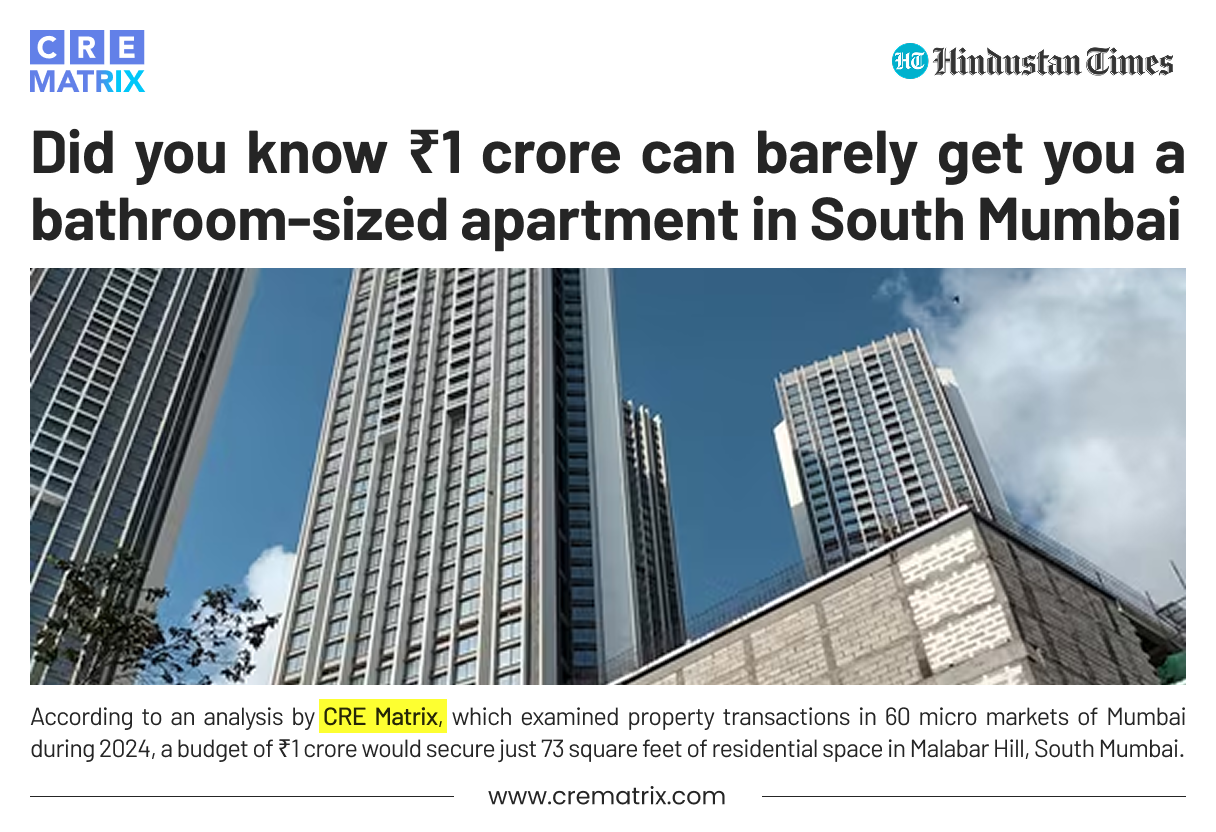
Mumbai’s real estate market remains India’s most expensive, with prime locations recording apartment prices of nearly ₹3 lakh per square foot. For homebuyers working with a ₹1 crore budget, options in premium neighbourhoods are extremely limited.

According to an analysis by CRE Matrix in its report, How Much Sqft Can You Buy in Mumbai for ₹1 Cr.?, which examined property transactions across 60 micro-markets in Mumbai during 2024, a ₹1 crore budget can buy just 73 sq ft in Malabar Hill, one of South Mumbai’s most premium residential areas. In Worli, the same budget covers roughly 100 sq ft, while Bandra offers around 124 sq ft—roughly the size of a compact bedroom.

How Much Space ₹1 Crore Buys in South and Central Mumbai

Other prime localities also offer limited space for ₹1 crore. In Lower Parel, buyers get about 136 sq ft, while Prabhadevi offers around 138 sq ft. Tardeo and Juhu provide marginally larger homes at approximately 147 sq ft and 172 sq ft, respectively.

Neighbourhoods such as Colaba, Dadar, Santacruz, and Khar fall in a similar bracket, offering roughly 174 to 200 sq ft within the same budget. These figures underline how central and South Mumbai continue to command premium pricing despite limited apartment sizes.

Suburban Markets Offer Better Value for ₹1 Crore

The stark contrast becomes evident as buyers move toward Mumbai’s suburban markets. In western suburbs like Andheri, Goregaon, Malad, Kandivali, Borivali, and Dahisar, ₹1 crore can fetch homes ranging between 270 and 530 sq ft. These areas continue to attract mid-income homebuyers due to relatively better space affordability and improved connectivity.

Eastern and Central Suburbs: More Space Within the Same Budget

Eastern and central suburbs offer comparable value. Localities including Ghatkopar, Wadala, Kurla, Sion, Chembur, Mulund, Vikhroli, Powai, Kanjurmarg, and Bhandup typically offer 280 to 500 sq ft homes within a ₹1 crore budget. These markets remain popular with working professionals due to proximity to business hubs and transport networks.

Most Affordable Areas in Mumbai for ₹1 Crore Homes

At the more affordable end of the spectrum, neighbourhoods such as Dharavi, Asalpha, Kurla, and Govandi offer the largest home sizes for the same budget. Here, ₹1 crore can secure 540 to 680 sq ft, highlighting the sharp affordability divide between South Mumbai and the city’s peripheral markets.

Additional Costs to Budget for When Buying a ₹1 Crore Home

Beyond the purchase price, buyers must factor in additional costs. Real estate consultants advise budgeting an extra 10% to 20% of the property value for expenses such as stamp duty, registration charges, development fees, and GST for under-construction properties.

Interior and furnishing costs may add another 10% to 15% of the total property value. Even in cases where banks fund a high percentage of the agreement value, homebuyers should be prepared with sufficient liquidity to manage these ancillary expenses.

Elevate your decisions in real estate as a developer or broker with CRE Matrix‘s data-driven insights. Book a demo now!

Media Mentions

Bengaluru’s Luxury Housing Market Crosses ₹1,000 Crore in Sales

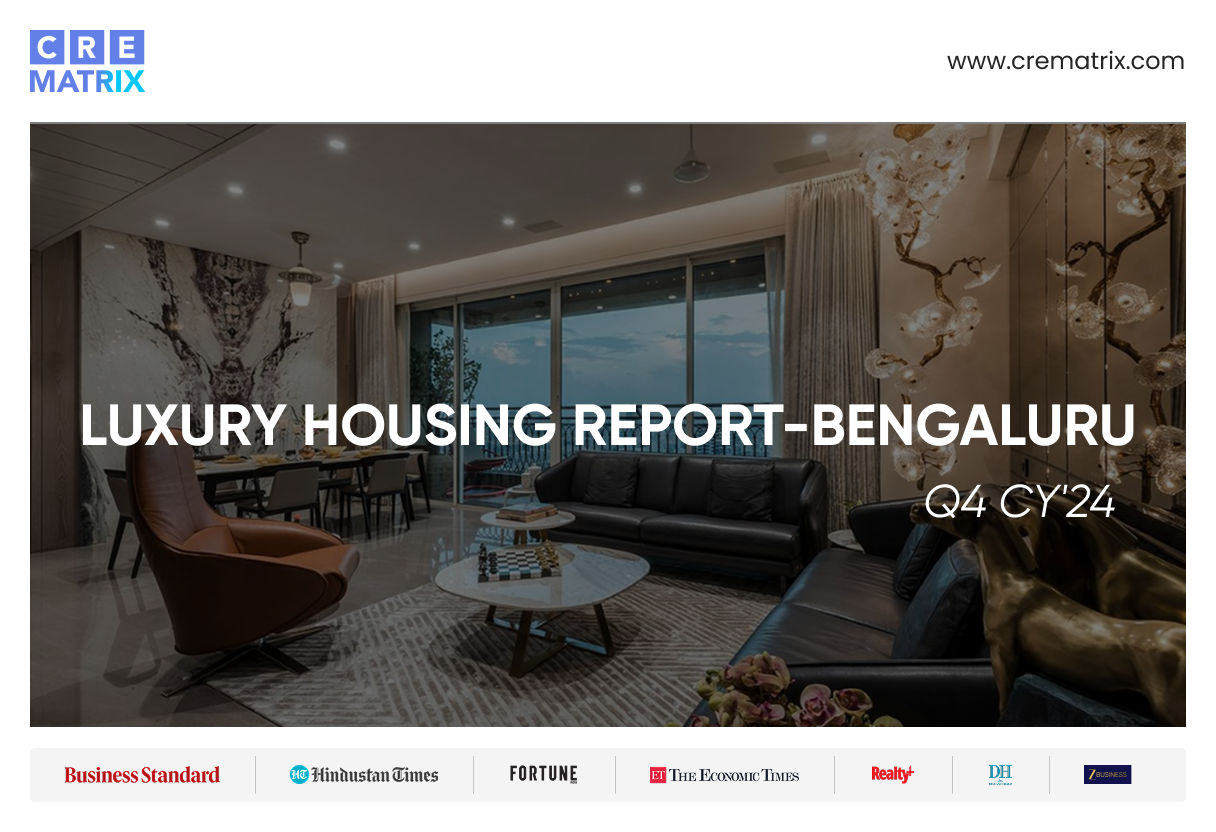
Luxury Housing Report-Bengaluru

Bengaluru’s luxury housing market hit a historic milestone in FY 2024–25, with cumulative sales of homes priced at ₹10 crore and above crossing ₹1,000 crore for the first time. As highlighted in the Luxury Housing Report FY’24–25 (Bengaluru) by India Sotheby’s International Realty and CRE Matrix, the segment witnessed nearly 59% year-on-year growth, underscoring the city’s growing stature in India’s high-end residential landscape.

Luxury Sales Accelerate Despite Limited Supply

The ₹1,000-crore milestone was achieved with a relatively small number of transactions—fewer than 150–200 ultra-luxury units. The popularity of the exceptionally high ticket sizes in this segment deserves recognition. Average deal values ranged between ₹10 crore and ₹25 crore per home, with select transactions surpassing this range.

Apartments priced between ₹10–12 crore witnessed the strongest demand, offering buyers a balance between exclusivity, size, and practicality. Limited inventory, controlled launches, and a clear shift by developers toward fewer, larger residences rather than volume-led projects helped sustain pricing and drive value growth.

High-Income Buyers Fuel Sustained Demand

Demand in Bengaluru’s luxury segment continues to be driven by CXOs, startup founders, promoters, and entrepreneurs. Many of them already own multiple properties. Clearly, these buyers are upgrading to luxury homes for enhanced space, privacy, and lifestyle-led living.

A notable trend is the rising preference for large-format luxury apartments ranging between 5,000 and 7,000 sq. ft. Features such as expansive floor plates, low-density developments, private elevators, and premium amenities are key decision drivers. Moreover, proximity to central business districts and established residential hubs continues to play a critical role in influencing buyer preference.

Hebbal Leads Bengaluru’s Luxury Micro-Markets

Among luxury micro-markets, Hebbal emerged as the top performer, contributing 22% of Bengaluru’s total luxury housing sales value. Additionally, strong connectivity, proximity to business hubs, and an evolving premium residential ecosystem have made it a preferred destination for high-net-worth buyers.

A Market Showing Long-Term Momentum

The data points to sustained momentum rather than a short-term spike. The number of luxury units sold has grown at a compound annual rate of 47% since FY 2022–23, indicating robust and consistent demand. While luxury homes form a relatively small share of overall housing volumes, their contribution to total residential value is rising steadily.

Bengaluru Joins India’s Top Luxury Housing League

Crossing the ₹1,000-crore annual sales mark places Bengaluru alongside India’s established luxury housing markets. For developers, the trend signals scope for selective and well-positioned luxury expansion. For buyers and investors, it reinforces Bengaluru’s potential for long-term capital appreciation and its growing stature as a premium residential destination.

As the city’s wealth base expands and high-end supply remains disciplined, Bengaluru’s luxury housing market appears well-positioned for continued, sustainable growth.

Elevate your decisions in real estate as a developer or broker with CRE Matrix‘s data-driven insights. Book a demo now!

Media Mentions

India’s Office Leasing Touches Record 81.7 MSF in 2024, IT/ITES Leads Demand

India’s Office Leasing Touches Record 81.7 MSF in 2024

India’s office leasing market hit a historic high in calendar year (CY) 2024, with leasing volumes touching 81.7 million square feet (MSF), the highest ever recorded, according to the joint CRE Matrix–CREDAI India Office Report Q4 CY’24. The market registered a 19 percent year-on-year increase. This growth indicates the resilience of occupier demand even as companies adapt to new workplace models amid global economic headwinds.

IT/ITES Drives Market Momentum

The IT/ITES sector emerged as the largest demand driver. These accounted for 42 percent of total leasing activity in 2024, a sharp rise from 28 percent in CY’23. This resurgence reflects technology firms’ renewed focus on expansion, consolidation into Grade A assets, and long-term portfolio planning.

According to the report, India’s top office markets—Bengaluru, Hyderabad, and Mumbai continued to dominate leasing activity. Together, these metros contributed 62 percent of total demand, registering a robust 20 percent YoY growth.

Rise of Large-Format Transactions

Large office deals played a defining role in 2024. Transactions exceeding 100,000 sq ft accounted for 41 percent of total leasing, growing 13 percent YoY. This trend was particularly pronounced in Bengaluru and Pune. Clearly, occupiers now prefer scalable, campus-style developments that offer operational efficiency and flexibility for future expansion.

Tightening Vacancies and Supply Constraints

An average demand-to-supply ratio of 1.5 in CY’24 led to declining vacancy levels across key micro-markets, including Delhi NCR, Mumbai Metropolitan Region (MMR), and Chennai. As a result, the Pan-India vacancy rate fell to 15.7 percent, down from 17.7 percent in CY’23.

The imbalance was especially visible in Q4 CY’24. At this point, office leasing demand stood at 17.9 MSF, while new supply lagged at 12.1 MSF. This, in turn, resulted in high rentals.

Flexible Workspaces Gain Further Ground

The co-working and flexible office segment continued its upward trajectory. Notably, they contributed 13 MSF to total leasing demand in 2024—well above the three-year average of 10 MSF. This represents a 30 percent increase, driven by rising enterprise adoption of managed and hybrid workspace models.

Demand from co-working operators grew 25 percent YoY, with Delhi NCR doubling its absorption and Bengaluru recording a 1.4x increase compared to CY’23.

Rentals Rise Amid Strong Fundamentals

Reflecting tightening market conditions, Pan-India office rental rates increased to ₹106 per sq ft, registering a 13 percent YoY growth. Hyderabad, Pune, and Mumbai were key contributors to this rental appreciation, supported by strong occupier demand and limited Grade A supply additions.

Grade A Office Stock Crosses 900 MSF

Despite a 19 percent decline in new completions—with total supply at 53.3 MSF in 2024—India crossed a major milestone of 900 MSF of Grade A office stock. Bengaluru and Hyderabad together accounted for 55 percent of the new supply. Looking ahead, India is expected to add 295.7 MSF of fresh Grade A office space by 2027, with IT/ITES expected to remain the dominant demand driver, followed by co-working (16 percent) and BFSI (12 percent) sectors.

Elevate your decisions in real estate as a developer or broker with CRE Matrix‘s data-driven insights. Book a demo now!

Media Mentions

Hyderabad Real Estate Snapshot – Q4 CY’24: Value Resilience and Office Market Strength

Hyderabad Real Estate Snapshot – Q4 CY’24

The Hyderabad real estate market in Q4 CY’24 showed signs of adjustment, balancing moderate activity with strong fundamentals. The latest CREDAI–CRE Matrix Hyderabad Housing Report – Q4 CY’24 highlights a shift toward higher-value transactions, reduced unsold inventory, and region-specific price appreciation, indicating sustained buyer confidence despite a slowdown in new launches and overall transaction volumes.

At the same time, Hyderabad’s office market continued to demonstrate strong momentum in Q4 CY’24. As per the CREDAI–CRE Matrix Hyderabad Office Report – Q4 CY’24, demand remained robust across Grade A/A+ spaces, driven by expanding GCC activity, rising co-working adoption, and large-format leasing transactions. Improved vacancy absorption, concentrated new supply in key commercial hubs, and long-term occupier confidence reinforced the city’s position as one of India’s most resilient office markets.

Residential Market: Lower Volumes, Stronger Value Metrics

The city recorded 16,644 residential unit sales in Q4 CY’24, marking a 22% YoY decline, with the total transaction value easing 9% YoY to ₹30,924 crore. New supply also moderated significantly, as only 11,081 units were launched, a 50% YoY drop, indicating a more measured approach by developers amid shifting demand dynamics.

Despite softer volumes, pricing strength remained intact. The average ticket size rose 17% YoY, highlighting sustained demand for larger and premium homes. Market efficiency improved meaningfully, with unsold inventory declining 14% YoY to 1,04,778 units, compared to 1,21,421 units in Q4 CY’23. On the pricing front, Hyderabad South West led the market with 15% YoY price appreciation, the highest across all regions during the quarter.

Notably, on a full-year basis, Hyderabad recorded residential sales worth ₹1.15 lakh crore in CY’24, marginally higher than Mumbai’s ₹1.05 lakh crore. This shift underscores Hyderabad’s growing depth as a high-value housing market, even as quarterly volumes show temporary moderation.

Office Market: Demand-Led Expansion Continues

Hyderabad’s office market delivered a strong performance in Q4 CY’24, supported by steady occupier demand and limited vacancy additions. Grade A/A+ vacancy levels declined by 1.5% YoY, reflecting improved absorption across key business districts.

Structural demand drivers remained firmly in place. Co-working space demand increased 26% in CY’24 compared to four years ago, while the GCC segment recorded an 8.6% CAGR in office occupancy over the past five years, reinforcing Hyderabad’s position as a preferred destination for global enterprises. Transaction sizes also scaled up, with office deals exceeding 1 lakh sq. ft. rising 2.2x between Q4 CY’23 and Q4 CY’24, indicating growing confidence among large occupiers.

On the supply side, Gachibowli dominated the market, accounting for 58% of new office completions in CY’24, further strengthening its status as the city’s primary commercial hub. In the broader context, Hyderabad also captured 17% of India’s Grade A office leasing in CY’24, placing it ahead of several larger metros, including Mumbai, in terms of annual leasing share.

Market Outlook

Taken together, the Q4 CY’24 data points to a market that is transitioning toward quality-led growth rather than volume-driven expansion. While the residential sector adjusts to near-term demand dynamics, strong office fundamentals continue to support employment growth, capital inflows, and long-term housing demand — positioning Hyderabad as one of India’s most resilient real estate markets.

Elevate your decisions in real estate as a developer or broker with CRE Matrix‘s data-driven insights. Book a demo now!

Media Mentions

India’s Grade A Warehousing Market Sees Strong Growth in 2024

India Grade A warehousing market 2024

India’s Grade A warehousing market recorded robust growth in 2024, driven by rising demand from logistics, manufacturing, and industrial occupiers. According to the Grade-A India Warehousing Report – Jan’24 by CREDAI and CRE Matrix, leasing activity for premium warehouse spaces is projected to cross 45 million sq ft for the year, with 20.3 million sq ft already absorbed in the first half of 2024.

Demand significantly outpaced new supply, which stood at 14.8 million sq ft during the same period. This imbalance pushed vacancy levels down to a record low of 8.2%. This indicates strong occupier confidence and limited availability of high-quality warehousing infrastructure across key markets.

Key Regional Trends

Western and northern markets led leasing activity, with the Mumbai Metropolitan Region, Pune, and the National Capital Region. Together, they account for nearly two-thirds of total Grade A warehousing demand in 2024.

  • Bengaluru recorded a 25% rise in Grade A supply in Q2 2024, marking a notable expansion in quality warehouse stock.
  • Pune emerged as a key demand hotspot, with demand outstripping supply by nearly 2x, signalling strong scope for future development.
  • Chennai also showed healthy traction, with a demand-to-supply ratio of 1.6x, indicating growing occupier interest.

Rentals Rise as Demand Tightens Supply

The supply-demand gap led to a 4% year-on-year increase in warehousing rental values across major markets. Third-party logistics (3PL) players, manufacturing companies, and electronics firms remained the biggest demand drivers, as businesses continued to upgrade to compliant, well-located Grade A facilities.

Outlook: Strong Growth Ahead

India’s Grade A warehousing stock is projected to exceed 300 million sq ft by 2025, supported by sustained investments in logistics infrastructure, manufacturing expansion, and the growth of e-commerce. With vacancy rates at historic lows and demand continuing to rise across major industrial corridors, the warehousing sector is expected to remain one of the strongest-performing real estate segments in the near term.

Elevate your decisions in real estate as a developer or broker with CRE Matrix‘s data-driven insights. Book a demo now!