
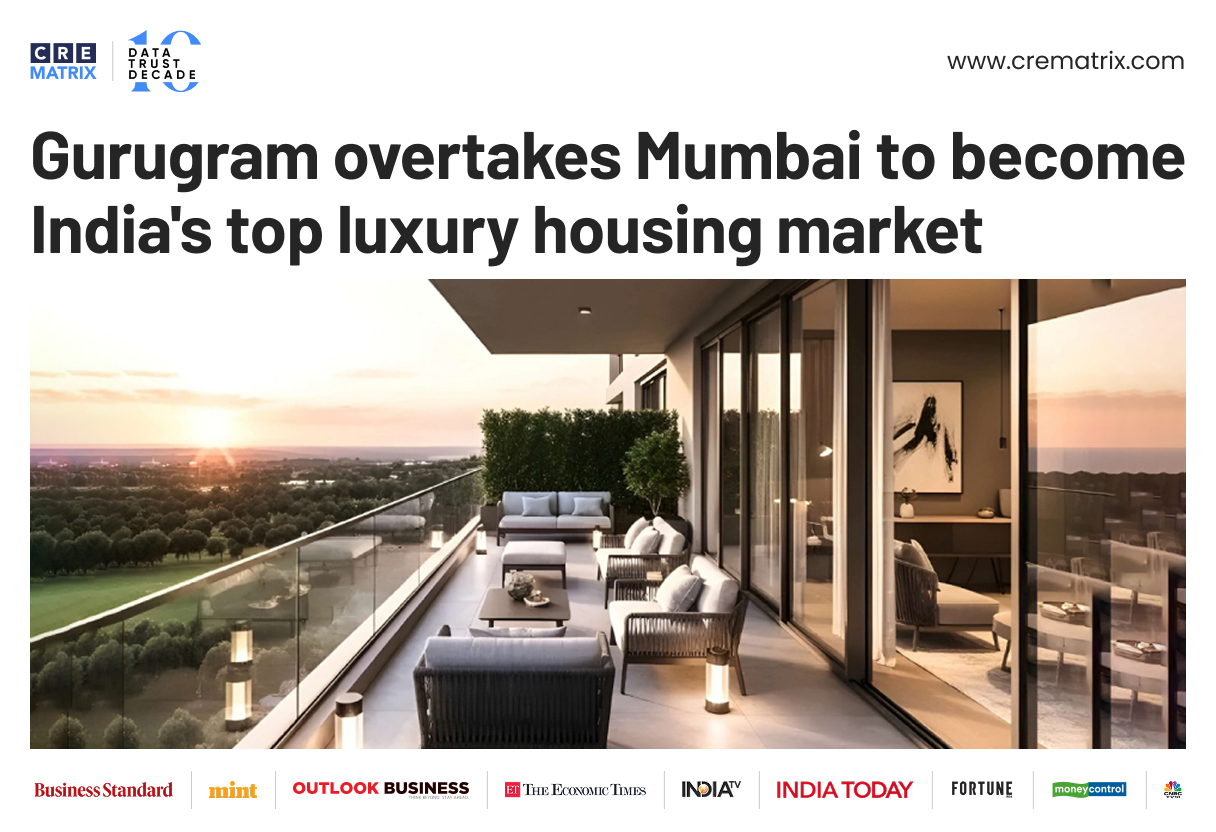
Gurugram has firmly established itself as India’s most dynamic ultra-luxury residential market in 2025. According to the Gurugram High-End Luxury Housing Report – CY 2025 by CRE Matrix in collaboration with India Sotheby’s International Realty, the city recorded an unprecedented ₹24,120 crore in luxury home sales during the calendar year.
This marks the highest-ever annual transaction value for homes priced at ₹10 crore and above in Gurugram — and the strongest performance by any city in this ultra-premium segment.
₹24,120 Crore in Sales: A Landmark Year
In CY 2025:
- 1,494 luxury homes (₹10 Cr+) were sold.
- Average ticket size stood at ₹16 crore.
- Average home size was approximately 5,000 sq. ft.
The ultra-luxury segment captured 24% market share (by value). The surge represents nearly a 10-fold jump in volumes since CY 2023, when just 155 units were sold in this price bracket.
The total transaction value grew dramatically from ₹4,004 crore in CY 2023 to ₹24,120 crore in CY 2025, reflecting strong wealth creation, rising investor confidence, and sustained appetite among HNIs and ultra-HNIs.
Gurugram Outpaces Mumbai in Luxury Sales
While Mumbai has traditionally dominated India’s premium housing landscape, CY 2025 saw Gurugram surpass Mumbai in total transaction value for homes priced above ₹10 crore.
This shift signals a structural change in India’s luxury housing geography, positioning Gurugram as the fastest-growing high-end residential engine among Tier 1 cities.
Other major markets such as Noida & Greater Noida, Hyderabad, and Bengaluru have shown growth, but none matched Gurugram’s scale and acceleration in the ₹10 crore+ category.
The Inflection Point: CY 2024 to CY 2025
CY 2024 marked a decisive turning point for Gurugram’s ultra-luxury housing market, as unit sales surged to 519 and transaction value climbed to ₹13,384 crore, setting the stage for an even stronger 2025. In CY 2025, volumes nearly tripled to 1,494 units, reflecting extraordinary demand momentum in the ₹10 crore and above segment.
This sharp acceleration highlights robust capital inflows, a rapidly expanding HNI and ultra-HNI base, greater regulatory transparency under RERA, and improved construction quality across premium developments. At the same time, buyers are increasingly gravitating toward branded, amenity-rich residences in prime micro-markets. Record IPO activity in India during 2025 further strengthened this momentum, creating a new wave of founders and entrepreneurs entering the luxury housing space and reinforcing Gurugram’s position as a leading ultra-premium residential hub.
Rise of ₹20 Cr and ₹40 Cr+ Homes
The data reveals growing depth in demand across higher price brackets within Gurugram’s ultra-luxury segment. Homes priced between ₹10–20 crore contributed over 80% of total units sold in CY 2025, forming the backbone of the market’s expansion.
At the same time, the ₹20–40 crore segment expanded sharply, rising from just 31 units in CY 2022 to 148 units in CY 2025. Even the ₹40 crore+ category witnessed steady growth, reflecting a clear appetite for ultra-exclusive residences.
This evolution signals a maturing buyer profile—one that prioritises prime locations, superior construction quality, branded developments, and lifestyle amenities over mere scale.
Dwarka Expressway: The Breakout Luxury Corridor
Among all micro-markets, Dwarka Expressway emerged as the undisputed leader in CY 2025. Units sold surged dramatically from 21 in CY 2024 to 630 in CY 2025, while transaction value skyrocketed from ₹383 crore to ₹8,347 crore. Weighted average prices also climbed from ₹23,622 per sq ft to ₹26,756 per sq ft, reflecting both rising volumes and price appreciation.
Large-scale luxury launches and the completion of key infrastructure transformed the corridor into Gurugram’s most active ultra-luxury hub. Projects such as Elan The Emperor, Whiteland Westin Residences, M3M Elie Saab, and Delphine Central Park Estates played a pivotal role in driving this momentum.
Golf Course Road: Premium but Inventory-Constrained
Golf Course Road continues to command the highest ticket sizes in the city and remains synonymous with established luxury living. However, total sales value declined 28% year-on-year in CY 2025, largely due to limited fresh inventory rather than any softening in demand.
The micro-market remains home to marquee developments such as DLF The Dahlias, DLF The Camellias, and Godrej Astra, reinforcing its position as Gurugram’s most prestigious address.
Golf Course Extension Road: Premiumisation in Action
Golf Course Extension Road recorded a remarkable 379% rise in transaction value, increasing from ₹693 crore to ₹3,319 crore year-on-year. Weighted average prices jumped sharply from ₹24,855 per sq ft to ₹37,899 per sq ft, highlighting strong premiumisation and the success of upscale project launches.
Developments such as Experion One 42, M3M Altitude, and Trump Towers Gurugram contributed significantly to this growth, positioning the corridor as one of the fastest-emerging luxury destinations in the city.
Bigger Homes, Bigger Aspirations
Luxury buyers in 2025 are clearly prioritising space and lifestyle. Homes sized between 4,000–6,000 sq. ft. dominated the market with 1,029 units sold, accounting for 54% of total value share, while residences above 8,000 sq. ft. contributed 22% by value. With an average home size of nearly 5,000 sq. ft., the data reflects a structural shift toward spacious, experience-driven living.
What’s Driving the Boom?
Rapid wealth creation, IPO-led liquidity, strong developer balance sheets, regulatory transparency under RERA, rising investments from global Indians, and major infrastructure upgrades power the surge. Together, these factors have transformed Gurugram from a satellite corporate hub into a globally aligned luxury residential destination.
CY 2025 stands out as a watershed year for Gurugram’s ultra-luxury housing segment. With record-breaking volumes, rising ticket sizes, expanding micro-markets, and strong capital formation, the city has cemented its position as India’s epicenter for ₹10 crore+ residences.
If current momentum sustains, Gurugram’s luxury real estate market is poised not just for cyclical growth — but for long-term structural expansion.
Elevate your decisions in real estate as a developer or broker with CRE Matrix‘s data-driven insights. Book a demo now!
Media Mentions
- Business Standard: Gurugram overtakes Mumbai to become India’s top luxury housing market.
- Mint: Gurugram luxury home sales surge 80% to ₹24,120 crore, overtakes Mumbai in 2025 – what’s fueling the demand?
- Outlook Business: Gurugram Beats Mumbai in Ultra Luxury Home Sale in 2025; 1,494 Units Sold for ₹24,000 Cr: Report.
- The Economic Times: Gurugram outpaces Mumbai in high-end luxury residential sale.
- India TV: Gurugram surpasses Mumbai in luxury home sales, records over Rs 24,000 crore transactions in 2025.
- India Today: Gurugram surpasses Mumbai in Rs 10-crore-plus home sales in 2025.
- Fortune India: Gurugram surpasses Mumbai in ultra-luxury home sales in 2025: Report.
- Money Control: Gurugram overtakes Mumbai to become India’s biggest Rs 10-crore-plus housing market.
- CNBC TV18: Gurugram overtakes Mumbai as India’s top market for ₹10 crore-plus luxury homes.