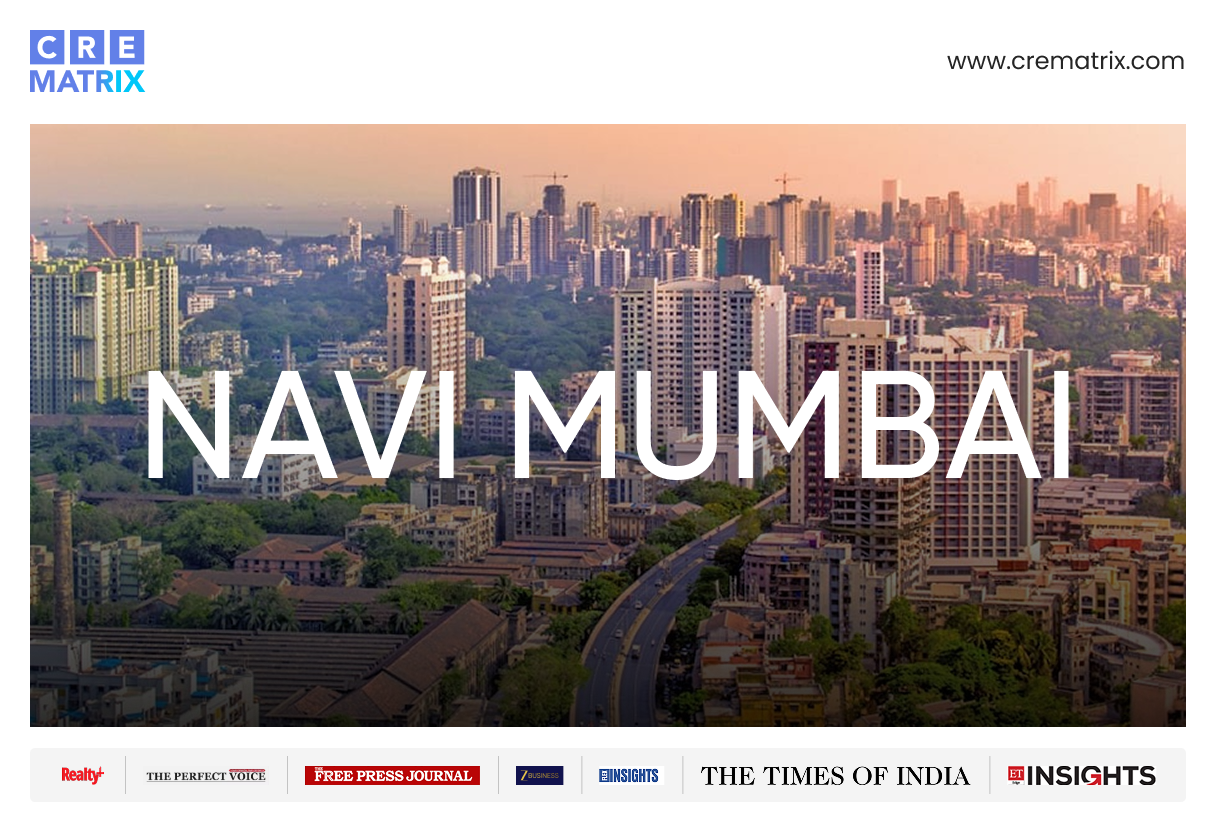
Navi Mumbai is rapidly evolving from a satellite city into a key growth engine within the Mumbai Metropolitan Region (MMR). According to CRE Matrix’s latest report, Navi Mumbai Rising: A Comprehensive Perspective on India’s Next Commercial Real Estate Hub, this transformation is being fueled by strong occupier demand, a growing supply of Grade A and A+ office spaces, ESG-compliant developments, enhanced connectivity, and large-scale infrastructure expansion.
From Satellite City to Core Office Market
The report highlights that Navi Mumbai is increasingly being positioned as a core office and employment destination, supported by a strong social and talent ecosystem. A robust education network ensures a scalable talent pipeline, while improved liveability helps employers attract and retain skilled professionals.
Residential expansion, retail growth, and a growing concentration of data centres further strengthen Navi Mumbai’s ability to function as a comprehensive business hub.
Infrastructure Catalysts Driving Growth
Navi Mumbai’s commercial ascent is being propelled by major infrastructure projects under the Mumbai 3.0 initiatives. Key developments include:
- Navi Mumbai International Airport
- Jawaharlal Nehru Port Trust (JNPT)
- Metro corridors and the Katai Naka Tunnel
- Atal Setu connectivity
These projects are reducing commute times and integrating Navi Mumbai more closely with Mumbai’s core economy, creating a seamless growth corridor.
Abhishek Kiran Gupta, CEO & Co-founder of CRE Matrix, stated that the next phase of commercial real estate growth in the MMR will be driven by Navi Mumbai, anchored on three key pillars—GCCs, green buildings, and gigawatts—positioning it as a large-scale institutional-grade business destination.
He highlighted that the city’s growth is strongly backed by data, including a 21% rental advantage attracting global capability centres, 23.5 msf of green building development, 628 MW of live IT load across 7.5 msf of data centres, and a robust 3,400+ MW upcoming data centre pipeline.
Residential and Ecosystem-Led Growth
Beyond offices, Navi Mumbai’s expansion is increasingly ecosystem-driven. From 2020 to 2025, the city recorded 13,205 housing units sold and 24,163 units supplied, with premium and luxury segments dominating sales. Over half of the homes sold exceeded 700 sq ft, indicating workforce stability and aspirational demand.
Cost Advantage and Green Office Stock
Navi Mumbai is emerging as a cost-competitive office destination, attracting multinational companies and Global Capability Centres (GCCs). Average office rentals in the city are around ₹70 per sq ft per month, which is approximately 21% lower than the average rents in Tier-1 markets.
This pricing advantage, combined with improving infrastructure and connectivity, is drawing corporate occupiers looking to optimise real estate costs while remaining close to Mumbai’s business ecosystem. Despite the affordability, the market has shown healthy momentum, with office rents growing at a compound annual growth rate (CAGR) of about 5.1% over the past three years, indicating stable and sustained demand.
The city currently has around 32.7 million sq ft of prime office stock with nearly 430 occupiers across key micro-markets. In addition, about 23.5 million sq ft of new office supply is expected by 2031, which will further expand the commercial landscape.
Sustainability is another defining feature of the market, with around 72% of the Grade A and A+ office stock being green-certified, among the highest shares in India. North Navi Mumbai currently leads the under-construction pipeline of green office developments, reinforcing the region’s shift toward sustainable and future-ready workspaces.
Emerging Data Centre Hub
The city is also emerging as a major data centre hub, with:
- 628 MW operational IT load across 7.5 million sq ft of data centre space
- Ranking third in Asia by operational IT load
- Projected to reach 3,400+ MW by 2035, positioning Navi Mumbai as Asia’s next data centre capital
Notably, about 77% of operational capacity is occupier-owned, highlighting strong institutional interest.
Liveability and Demographics
Navi Mumbai’s appeal is further enhanced by:
- 41% lower congestion compared to Mumbai
- Better air quality and less crowded public transport
- Housing costs are 20–30% lower than in the core Mumbai regions
- Predominantly middle-income population, supporting stable consumption and workforce
Large-Scale Infrastructure Investment
Infrastructure investment continues to drive growth:
- Rs 80,000 crore invested in transformational projects like the Navi Mumbai International Airport, expected to generate 50,000+ jobs
- Rs 95,000 crore invested in roads across 200 km of upcoming corridors
With robust infrastructure, a skilled talent pool, cost advantages, and a growing green and digital footprint, Navi Mumbai is moving from potential to performance. It is rapidly becoming the preferred destination for office leasing, large-scale investments, and the next core commercial hub of the Mumbai Metropolitan Region.
Elevate your decisions in real estate as a developer or broker with CRE Matrix‘s data-driven insights. Book a demo now!
Media Mentions