
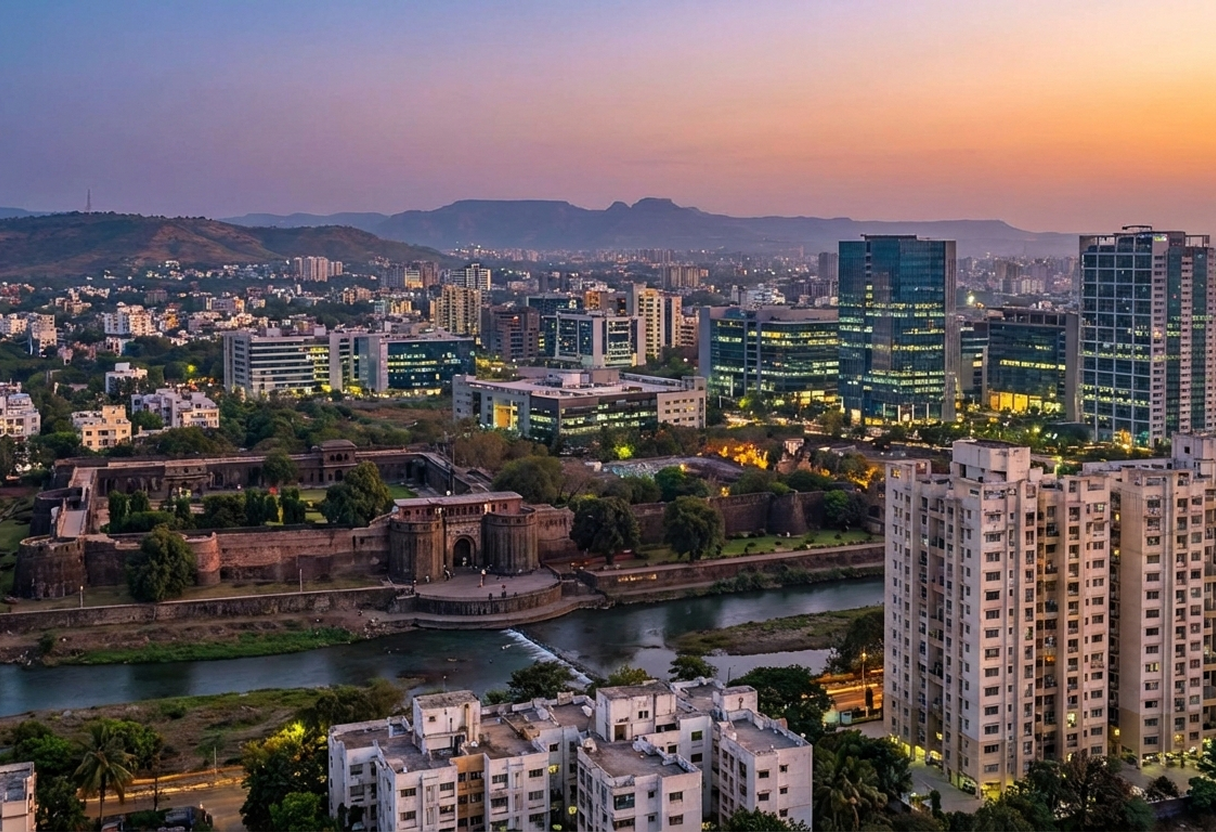
Pune’s residential real estate market is showing clear signs of divergence. While overall sales value continues to rise, housing demand in the city’s IT-dominated western and eastern zones has moderated, reflecting a mix of global uncertainty, job market concerns, and sharp price appreciation.
IT Hubs Feel the Pressure
According to data from Credai Pune and CRE Matrix, home sales in Pune’s western and eastern zones declined marginally in the first half of 2025. These areas, home to major IT clusters, recorded 15,845 units sold between January and June, compared to 16,372 units in the same period last year.
The western zone spans Baner, Aundh, Hinjewadi, and Wakad, while the eastern zone includes Yerawada, Viman Nagar, Kalyani Nagar, and Kharadi. Together, these locations typically account for 40–60% of Pune’s total housing transactions, making even a modest slowdown significant for the city’s broader market.
Industry observers point to stress in the IT employment environment as a key factor. Global trade tensions and tariff-related uncertainties, particularly linked to the US market, have added to concerns around job stability, dampening buying sentiment among tech professionals.
Prices Rise Faster Than Volumes
Despite the dip in the number of units sold, the value of transactions has continued to grow. Average home prices in Pune have risen by about 27% over the last three years, with premium housing demand accelerating sharply.
Homes priced above ₹1 crore have more than doubled in sales, highlighting a strong preference for larger, higher-ticket properties. In micro-markets such as Baner, Balewadi, and Kharadi, 2 BHK apartments now cost upwards of ₹1.2 crore, while 3 BHK units are typically priced above ₹1.7 crore.
This trend indicates that while some budget-sensitive buyers are pausing purchases, affluent buyers are still active, often upgrading to larger homes rather than opting out of the market.
East Pune, meanwhile, maintained a steady performance, contributing roughly 25% of new launches and 22% of overall sales. While demand here has not collapsed, it has clearly lost some momentum compared to previous years.
Sticker Shock and Changing Buyer Preferences
Developers believe affordability is becoming a growing concern. Over the past five years, average apartment ticket prices in Pune have jumped by nearly 40%, while average home sizes have increased by about 25%. This combination has pushed many homes beyond the reach of first-time or mid-income buyers.
Some industry leaders suggest that reducing unit sizes, without cutting headline prices, could help revive demand among buyers with fixed budgets. Smaller configurations may allow developers to maintain pricing while making homes more accessible to a broader segment of the market.
Outlook: Value Growth, Volume Caution
Pune’s housing market is not facing a downturn, but it is clearly recalibrating. Demand in IT-centric micro-markets is becoming more selective, influenced by employment uncertainty and sharp price escalation. At the same time, rising sales value underscores a sustained appetite for premium and spacious homes.
In the near term, the market’s direction will likely depend on clarity in the global IT outlook and how developers respond to affordability pressures. For now, Pune’s real estate story remains one of higher value growth, but with cautious volumes in its traditional IT strongholds.
Elevate your decisions in real estate as a developer or broker with CRE Matrix‘s data-driven insights. Book a demo now!