
India’s organised retail market is expanding beyond the traditional shopping mall. Across 12 major markets, the sector now spans 186.2 msf of organised retail stock, with shopping malls, office-led amenity retail and high streets each playing a distinct role.
The latest India Real Estate Horizons | Retail 2026 report by CRE Matrix highlights how the next phase of retail growth is being shaped by larger malls, experience-led tenant mixes, workplace-linked retail and significant upcoming supply.
How large is India’s organized retail market?
India’s organized retail stock stands at 186.2 msf across 12 markets. Shopping malls account for the largest share at 114.3 msf, followed by 51.7 msf of Office-Led Amenity Retail and 20.2 msf of High Streets.
This composition shows how organised retail is becoming more diverse. Retail activity is no longer concentrated only in purpose-built malls. Grade A and A+ office developments increasingly incorporate dedicated retail space, while established high streets continue to serve strong consumer catchments.
The report also recorded 2.1 msf of shopping mall leasing in H1 2026, against 1.4 msf of new supply, indicating that leasing demand remained ahead of new mall additions at the national level.
Which cities have the largest organized retail stock?
Bengaluru leads India’s organised retail stock at 29.2 msf, followed by:
- Gurgaon: 27.4 msf
- Hyderabad: 24.8 msf
- Mumbai: 23.8 msf
However, the composition of retail stock varies significantly across these markets. Bengaluru has a strong shopping mall base, while Gurgaon has emerged as the largest market for office-led amenity Retail. Mumbai has a more balanced retail ecosystem comprising shopping malls, office-led retail and high streets.
This means retail market size cannot be assessed through mall stock alone. The mix of formats is becoming an important part of how individual cities are developing.
One of the report’s major findings is the rapid growth of Office-Led Amenity Retail.
The segment has reached 51.7 msf, with dedicated retail within Grade A and A+ office developments becoming an increasingly important part of organised retail.
The report identifies 15.4 msf of dedicated office-led retail additions between 2021 and 2025, the highest five-year addition recorded. This represents roughly a 10x increase in five-year additions compared with the pre-2000 period.
Gurgaon leads the segment with 10.0 msf, followed by Mumbai at 8.4 msf and Pune at 7.4 msf. Together, these three markets account for nearly half of the national Office-Led Amenity Retail stock. The trend reflects the growing integration of dining, wellness, services, and other consumer-facing uses within major workplace developments.
Where is India’s next wave of mall supply coming from?
India has 40.4 msf of upcoming Shopping Mall supply identified through 2030.
The pipeline is highly concentrated. Hyderabad and Gurgaon together account for 51% of the identified supply, with:
- Hyderabad: 12.1 msf
- Gurgaon: 8.6 msf
- Bengaluru: 4.7 msf
- Delhi: 4.4 msf
- Noida: 4.2 msf
- Chennai: 3.6 msf
- Thane: 1.5 msf
The concentration of supply points to a more selective mall development cycle, particularly across expanding residential, office, and infrastructure-led corridors.
Are India’s new malls getting bigger?
Yes. The upcoming mall pipeline indicates a significant increase in average mall size.
The average size of a new shopping mall is expected to rise from 0.33 msf during 2021-25 to around 0.59 msf during 2026-30.
This is more than simply an increase in floor space. Larger malls can accommodate broader tenant mixes, larger entertainment formats, stronger F&B clusters, wellness offerings and other experiential uses.
The report also estimates that shopping mall stock could reach 154.7 msf by 2030, compared with 112.6 msf in 2025.
How is the shopping mall tenant mix changing?
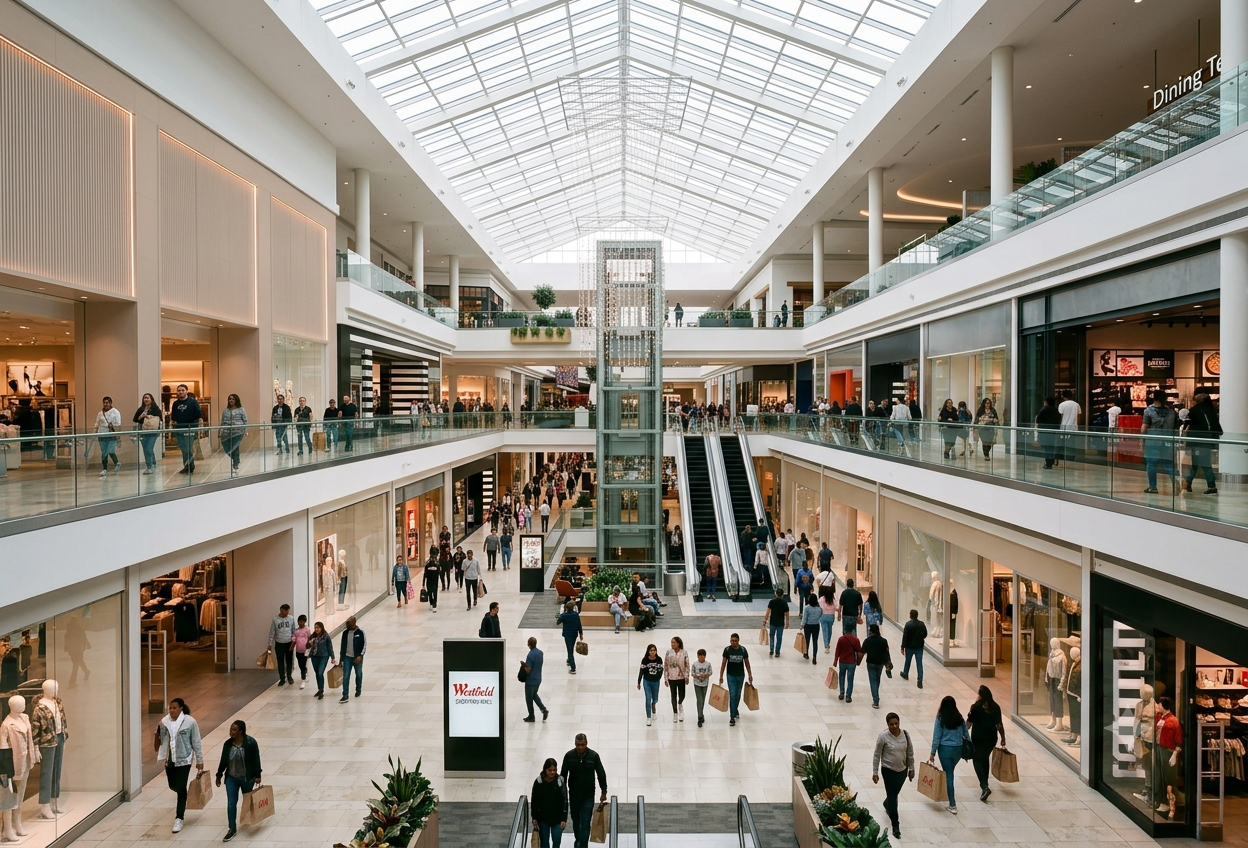
The Indian shopping mall is increasingly becoming an experience-led destination.
The Indian shopping mall is increasingly becoming an experience-led destination.
Experience-led and discretionary categories such as Apparel & Fashion, Food & Beverages, Entertainment, Accessories & Leisure and Beauty & Wellness increased their combined share of mall leasing from 54% in 2013-15 to 72% in 2023-25.
Apparel & Fashion alone increased from 25% to 35%, while Food & Beverages rose from 11% to 15%.
At the same time, traditional anchor categories have lost share. Department Stores & MBR and Essentials & Grocery together declined from 31% to 11%.
The shift indicates that malls are increasingly being designed around multiple reasons to visit rather than relying primarily on traditional anchor stores.
Which cities are seeing stronger mall rental growth?
Shopping mall rentals have recorded growth across multiple markets, but the pace differs considerably by market.
Pan-India shopping mall rentals increased 11% over three years, while Mumbai and Bengaluru recorded the strongest three-year growth at 22% each.
Mumbai also recorded the highest shopping mall passing rent among the markets tracked, at ₹438 per sq ft per month in H1 2026.
Hyderabad recorded the fastest one-year rental growth in the report, highlighting the strengthening performance of emerging retail destinations.
The difference between cities is also visible across retail formats. High streets can command substantially higher rents than shopping malls in established markets. Gurgaon’s High Street rentals, for example, reached ₹965 per sq ft per month, while Mumbai’s shopping mall rents stood at ₹438 per sq ft per month.
What does the retail market look like across major cities?
Retail performance varies significantly across markets.
Bengaluru leads total organised retail stock at 29.2 msf. It recorded 0.4 msf of mall leasing in H1 2026 with no new mall supply during the period, while passing rents reached about ₹246 per sq ft per month.
Gurgaon has 27.4 msf of organised retail stock and the country’s largest Office-Led Amenity Retail base at 10.0 msf. Its mall pipeline stands at 8.6 msf.
Hyderabad has 24.8 msf of organised retail stock and the largest upcoming mall pipeline at 12.1 msf. Its shopping mall vacancy remained low at 2.8% in H1 2026.
Mumbai has 23.8 msf of organised retail stock and recorded 0.5 msf of mall leasing without new supply in H1 2026. Its passing mall rent reached ₹438 per sq ft per month.
These markets illustrate the different ways retail ecosystems are developing across India, from mall-led growth to workplace-linked retail and established high-street networks.
What does this mean for India’s next retail cycle?
India’s retail market is moving into a phase where scale, format and consumer experience are becoming increasingly interconnected.
The next wave is not simply about adding more retail space. New malls are becoming larger and more destination-oriented. Office developments are incorporating dedicated retail ecosystems. High streets continue to command strong pricing in established catchments. At the same time, tenant demand is shifting towards fashion, F&B, entertainment, leisure and wellness.
With 186.2 msf of organised retail stock, 40.4 msf of upcoming mall supply, and a growing 51.7 msf Office-Led Amenity Retail segment, India’s retail real estate landscape is becoming more diverse across both assets and cities.
For developers, retailers, investors and occupiers, understanding this city-level and format-level divergence will be increasingly important as the next retail cycle takes shape.
Want deeper insights into India’s retail market?
Track retail stock, upcoming supply, rental trends, and city-level market dynamics with CRE Matrix. Book a demo!