

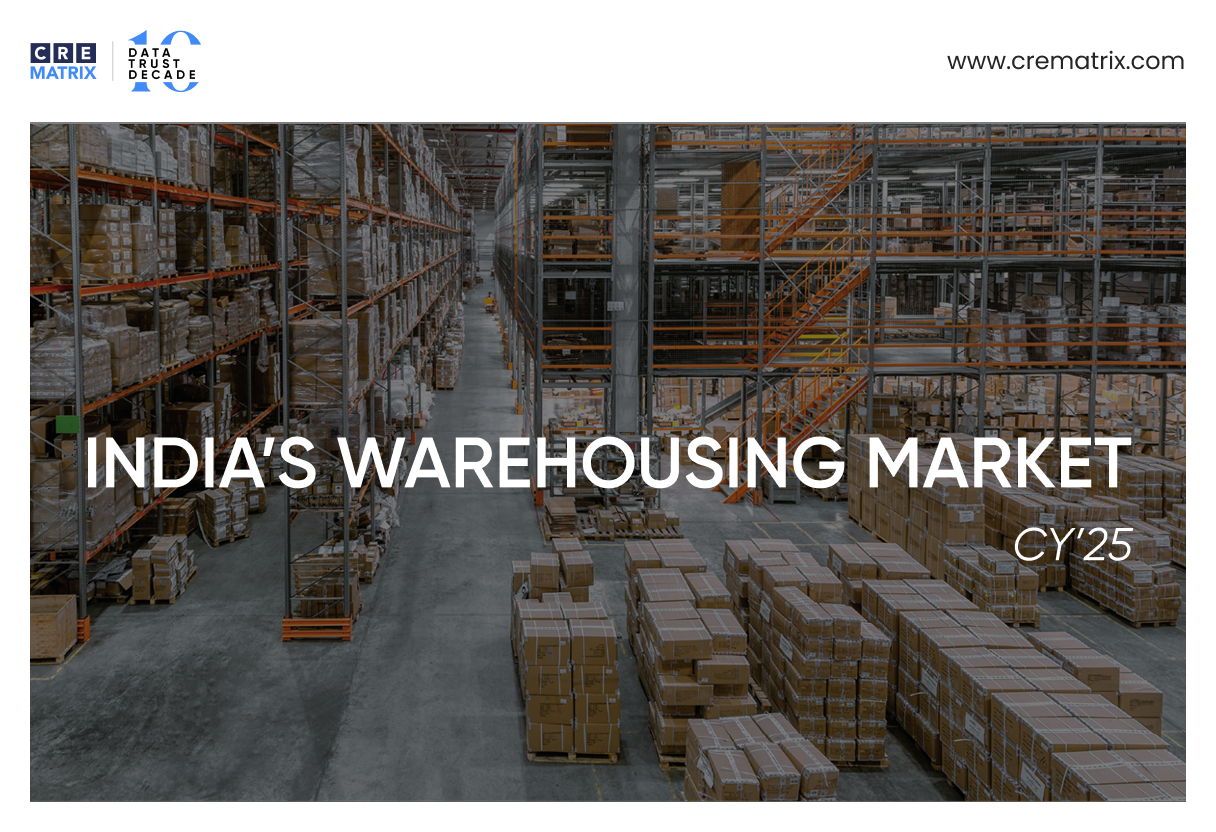
India’s warehousing market reached a major milestone in CY’25. According to the latest Grade A India Warehousing Report – Q4 CY’25, it highlights strong growth in the logistics sector. The report was released by CRE Matrix with CREDAI National.
The report shows that Grade A and A+ warehouse stock in India has crossed 401.8 million sq ft. This reflects the fast growth of modern logistics infrastructure in the country. Many companies are expanding their supply chains. As a result, demand for warehouses continues to rise.
Logistics firms, manufacturing companies, and e-commerce players are driving this demand. Therefore, developers are building more Grade A warehouses across major logistics hubs.
India’s Warehousing Market Performance in CY’25
India’s warehousing market saw strong activity in CY’25. Total leasing demand reached 73.2 million sq ft during the year. This shows a 23 percent increase compared to last year.
Meanwhile, developers also increased construction. Total supply reached 56.3 million sq ft in CY’25. This represents a 39 percent year-on-year increase.
However, the market remained stable. Demand stayed higher than new supply. The demand-to-supply ratio stood at 1.3X during the year.
At the same time, vacancy levels improved. Vacancy declined to 6.6 percent across the top seven cities. Moreover, 3PL logistics, manufacturing, and automotive sectors drove most of the demand.
India’s Warehousing Market City-Wise Trends
India’s warehousing market is supported by several major logistics hubs. Each city contributes to the development of modern supply chains across the country.
Pune
Pune emerged as the largest warehousing market in CY’25. The city accounted for about 21 percent of total demand and around 23 percent of supply across India. Moreover, strong industrial activity continues to support warehouse development in locations such as Chakan, Talegaon, and Ranjangaon.
NCR
NCR remains one of the most important logistics markets in India’s warehousing market. The region contributed around 20 percent of total demand and about 20 percent of supply in CY’25. Meanwhile, major warehouse clusters are located in Gurugram, Manesar, Bhiwadi, and Dadri.
MMR
The Mumbai Metropolitan Region continues to be a major warehousing hub. This is mainly due to its strong consumption base and port connectivity. As a result, MMR accounted for about 15 percent of total demand and around 16 percent of supply in CY’25. Locations such as Bhiwandi, Kalyan, and Navi Mumbai remain key logistics centres.
Bengaluru
Bengaluru also continues to see strong demand in India’s warehousing market. This growth is supported by e-commerce expansion and rising consumption. Similarly, the city accounted for around 15 percent of demand and about 17 percent of supply in CY’25. Major logistics clusters include Hoskote, Hosur Road, and Nelamangala.
Chennai
Chennai remains an important logistics hub in South India. The city contributed about 7 percent of demand and around 7 percent of supply in CY’25. Moreover, strong manufacturing activity supports warehouse demand in areas such as Sriperumbudur and Oragadam.
Hyderabad
Hyderabad is a fast-growing logistics market. The city accounted for around 3 percent of total demand and about 7 percent of supply in CY’25. Meanwhile, key logistics locations include Patancheru, Shamshabad, and Medchal.
Ahmedabad
Ahmedabad is emerging as a regional logistics hub in western India. The city contributed around 3 percent of total demand and about 3 percent of supply in CY’25. Therefore, industrial growth and regional connectivity continue to support warehouse development.
Future Outlook for India’s Warehousing Market
India’s warehousing market is expected to grow steadily in the coming years. Demand for modern logistics facilities continues to increase across major markets. In fact, the report shows that leasing demand grew by 23 percent in CY’25.
At the same time, vacancy levels are improving across key cities. Vacancy has declined to 6.6 percent across the top seven warehousing markets. As a result, this indicates steady absorption of Grade A warehouse space.
Moreover, rising consumption and e-commerce expansion will continue to drive warehouse demand. Developers are also building larger logistics parks across key markets.
Overall, India’s warehousing market will remain an important part of the country’s supply chain and economic growth.
Elevate your decisions in real estate as a developer or broker with CRE Matrix‘s data-driven insights. Book a demo now!