

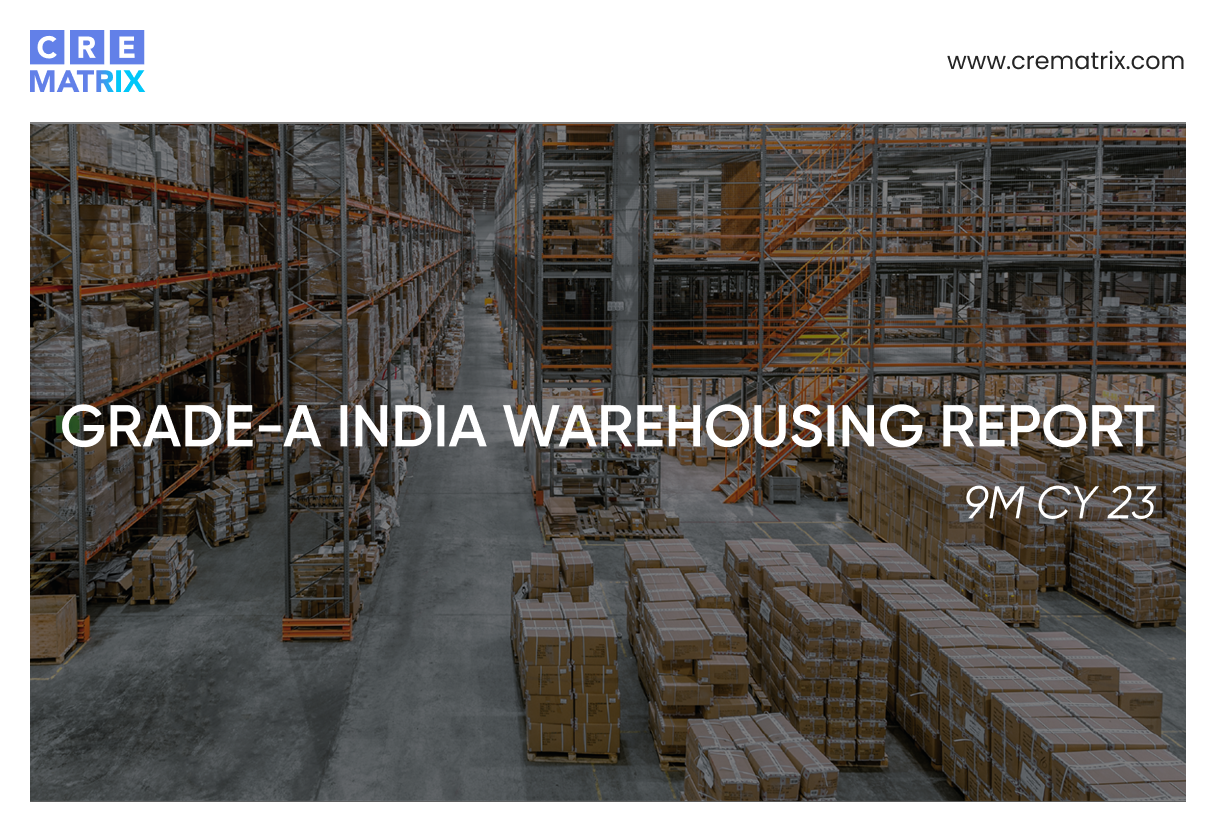
India’s warehousing sector has emerged as one of the fastest-growing segments within commercial real estate, with 2023 marking a significant inflection point. According to the Grade-A India Warehousing Report 9M CY 23 by CRE Matrix and CREDAI, the warehousing sector surpassed office space demand by 3.5% during the first nine months of the year. This is particularly noteworthy given that the warehousing sector is nearly 25 years younger than the office segment, yet it continues to rapidly close the gap in scale and maturity.
Key Growth Drivers of India’s Warehousing Sector
Multiple structural factors have driven the growth of the Indian warehousing sector in 2023. This includes rising consumption across income groups, expansion of the Production Linked Incentive (PLI) scheme across 14 sectors, and accelerated infrastructure development. As a result, total warehousing demand is expected to reach between 65 and 70 million square feet (msf) by the end of the year. This indicates the sector’s expanding role in India’s economic growth and supply chain transformation.
Rising Rents and Declining Vacancy Levels
A key trend shaping the Grade A warehousing market is the persistent demand-supply imbalance, which has led to a steady increase in rental values. Market rents have risen by 8.3% year-on-year, supported by strong occupier activity and limited availability of high-quality assets. At the same time, vacancy levels have tightened. These have declined by 1.3% compared to the previous year across the top six cities. Pan-India vacancy currently stands at 8.8%, reflecting a healthy market with sustained absorption. Passing rents have reached ₹25.1 per square foot per month. On the other hand, market rents have climbed to ₹26.7 per square foot per month, indicating continued upward pressure on pricing.
Demand-Supply Dynamics in Grade A Warehousing
From a supply and demand perspective, the numbers further reinforce the strength of the sector. During the first nine months of 2023, warehousing demand stood at 25.1 msf, significantly outpacing supply, which was recorded at 19.6 msf. India’s total Grade A warehousing stock has now reached 187 msf. Meanwhile, the gap between demand and supply continues to create favorable conditions for developers and investors focusing on premium logistics assets.
NCR and Pune Lead Warehousing Activity
Regionally, the warehousing market remains highly concentrated, with Delhi-NCR and Pune emerging as the dominant hubs. Together, these two markets contributed 53% of total warehousing demand and 49% of total supply during the year. Their strategic location advantages, strong industrial base, and robust connectivity infrastructure have made them preferred destinations for occupiers across sectors.
Manufacturing Emerges as the Largest Demand Driver
In terms of occupier demand, the manufacturing sector has taken the lead, accounting for 28% of total leasing activity. This is followed by strong contributions from third-party logistics (3PL), e-commerce, retail, and automotive sectors. The prominence of manufacturing highlights the ongoing shift toward domestic production and supply chain localization. This further strengthens the demand for high-quality warehousing infrastructure.
City-wise Warehousing Market Performance
Delhi-NCR
Delhi-NCR continues to be the largest warehousing market in India, with demand reaching 6.5 msf and total stock at 57.5 msf. The region has also witnessed an 11.9% increase in market rents over the past year. This indicates a strong occupier interest and sustained leasing activity across key industrial corridors.
Mumbai Metropolitan Region (MMR)
The Mumbai Metropolitan Region (MMR) commands the highest rental values in the country. The market rates have touched ₹33.6 per square foot per month. The region recorded 6.3 msf of demand and maintains a stable vacancy level of 9.5%, supported by steady growth in consumption and strong port-led logistics activity.
Pune
Pune has emerged as one of the most dynamic warehousing markets. The demand stands at 6.7 msf, and vacancy levels are at a relatively low 7.5%. The city has witnessed a 1.8 times increase in absorption compared to its three-year quarterly average. This is driven largely by the automotive and manufacturing sectors, making it a key logistics and industrial hub.
Bengaluru
Bengaluru stands out for its tight market conditions, with vacancy levels as low as 5.6%, indicating strong demand and limited supply additions. The city recorded 2.9 msf of demand during the period, supported by growth in e-commerce, third-party logistics, and industrial occupiers.
Chennai
Chennai is gaining traction as an emerging warehousing hub, recording 1.5 msf of demand. The city has seen significant supply growth, nearly 1.8 times quarter-on-quarter. Strong demand from the manufacturing sector and industrial occupiers is the primary driving force behind this.
Hyderabad
Hyderabad, while smaller in scale, is steadily evolving as a warehousing market with improving fundamentals. The city recorded demand of 1.2 msf and witnessed a 7.2% increase in passing rents, reflecting growing occupier interest and gradual market maturation.
Overall, the Indian warehousing sector in 2023 reflects strong structural growth, driven by economic expansion, supportive policy initiatives, and evolving supply chain needs. As demand continues to outpace supply, rental values are rising steadily, while vacancy levels are tightening. Consequently, the sector is well-positioned for sustained growth in the coming years. Moreover, as businesses increasingly prioritize efficiency, scalability, and proximity to consumption centers, Grade A warehousing will remain a critical component of India’s commercial real estate landscape.
Elevate your decisions in real estate as a developer or broker with CRE Matrix‘s data-driven insights. Book a demo now!