
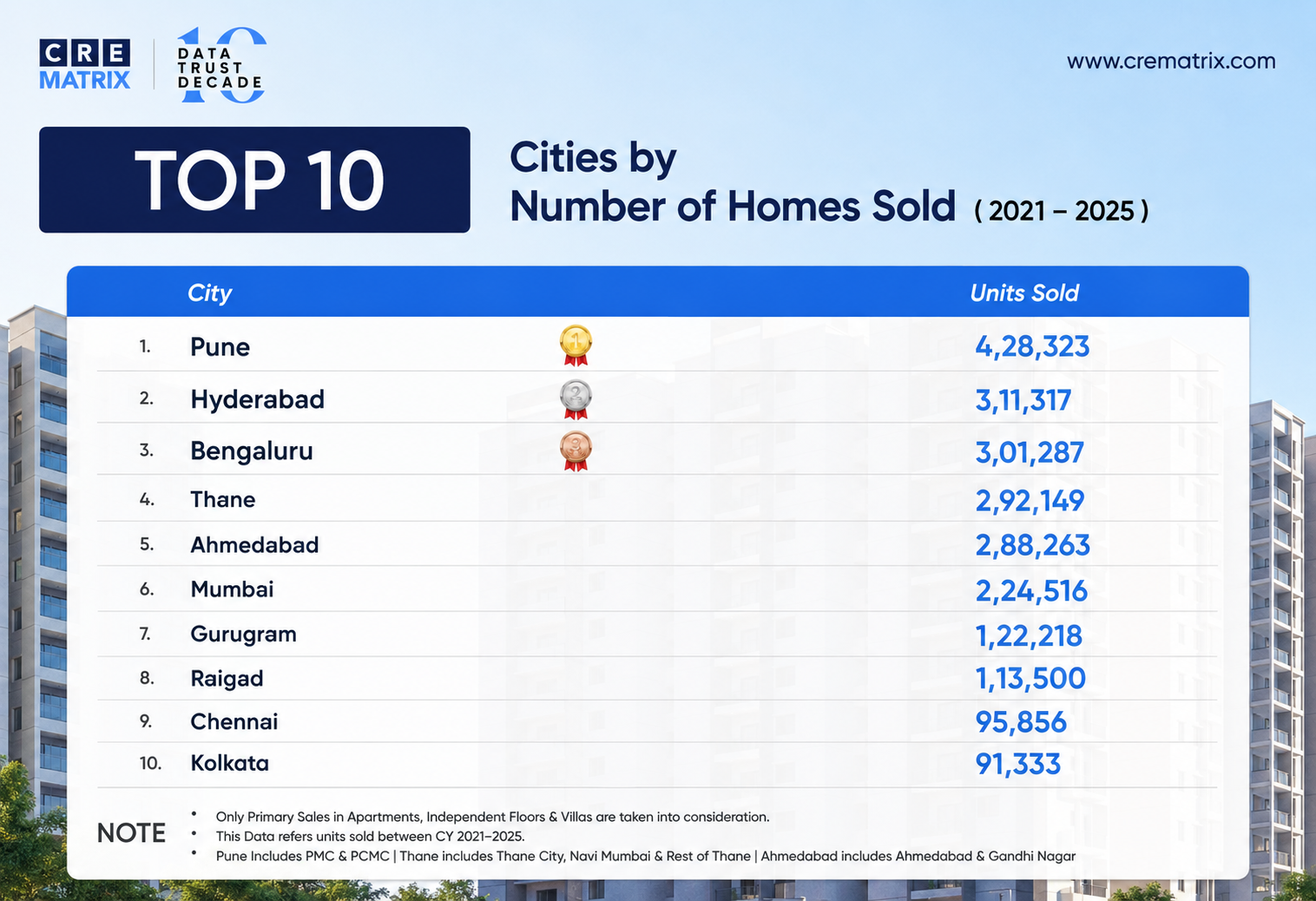
India’s residential real estate market has witnessed remarkable growth over the last five years, driven by strong end-user demand, improving affordability, infrastructure expansion, and increasing confidence in homeownership. An analysis of residential sales registrations between 2021 and 2025 reveals the cities that have emerged as the country’s strongest housing markets.
According to CRE Matrix housing data, the top 10 cities collectively recorded over 22.69 lakh housing units sold during the period. Pune, Hyderabad, and Bengaluru led the rankings, accounting for nearly 45% of the total homes sold among the top-performing cities.
How Home Sales Reflect Housing Market Performance
Home sales are one of the most widely used indicators of residential market performance because they provide a direct measure of buyer demand and market activity. A higher number of homes sold typically indicates strong consumer confidence, healthy economic conditions, and sustained demand for housing. Conversely, declining sales volumes may signal affordability challenges, weaker demand, or changing market sentiment.
Home sales data also helps assess a market’s ability to absorb new housing supply. Cities with consistently high sales volumes often attract greater developer investment, leading to new project launches and infrastructure development. Additionally, transaction trends can reveal emerging residential hotspots, shifts in buyer preferences, and the relative strength of different housing markets. By analyzing the number of homes sold over time, stakeholders can better understand market momentum, growth potential, and overall residential real estate performance.
Which Cities Recorded the Highest Home Sales in India Between 2021 and 2025?
Residential home sales provide valuable insights into the strength and maturity of a housing market. Based on CRE Matrix Housing Intelligence data, the following cities recorded the highest number of homes sold between 2021 and 2025.
Pune
With 4,28,323 homes sold, Pune emerged as India’s most active residential market between 2021 and 2025. Strong IT-led employment, expanding infrastructure, and sustained buyer demand continue to drive sales. Demand for flats in Pune remains concentrated across Hinjewadi, Baner, Wakad, Kharadi, and Tathawade.
Hyderabad
Hyderabad secured the second position with 3,11,317 homes sold during the period. The city’s thriving technology ecosystem and growing business districts continue to attract homebuyers. Flats in Hyderabad are seeing sustained demand across prominent locations including Gachibowli, Kokapet, Financial District, and Kondapur.
Bengaluru
Bengaluru recorded 3,01,287 homes sold, reflecting the city’s continued appeal as India’s technology capital. Strong job creation and infrastructure expansion have supported demand for flats in Bengaluru, particularly in Whitefield, Sarjapur Road, Electronic City, and North Bengaluru.
Thane
With 2,92,149 homes sold, Thane ranked fourth among India’s top residential markets. Improved connectivity, metro infrastructure, and affordability have strengthened demand for flats in Thane, especially along Ghodbunder Road, Majiwada, and Kolshet Road.
Ahmedabad
Ahmedabad registered 2,88,263 homes sold between 2021 and 2025. Industrial growth and expanding residential corridors have fueled demand for flats in Ahmedabad across locations such as South Bopal, Shela, Gota, and SG Highway.
Mumbai
Mumbai recorded 2,24,516 homes sold, demonstrating the city’s enduring housing demand despite higher property prices. Redevelopment activity and infrastructure upgrades continue to support demand for flats in Mumbai across multiple housing segments.
Gurugram
With 1,22,218 homes sold, Gurugram remained one of North India’s strongest residential markets. Corporate expansion and premium housing developments continue to drive demand for flats in Gurugram.
Raigad
Raigad recorded 1,13,500 homes sold, highlighting growing interest in peripheral residential markets. Improved connectivity and affordability have attracted both homebuyers and investors to the region.
Chennai
Chennai registered 95,856 homes sold during the five-year period. Supported by its manufacturing and technology sectors, demand for homes in Chennai remains strong across key residential corridors such as OMR and Porur.
Kolkata
Kolkata recorded 91,333 homes sold between 2021 and 2025. Affordable housing options and infrastructure improvements continue to support demand for flats in Kolkata, particularly in New Town, Rajarhat, and EM Bypass.
CRE Matrix Housing Intelligence: Tracking India’s Residential Growth
CRE Matrix provides housing data that tracks housing registrations, residential launches, developer activity, transaction trends, inventory movement, and micro-market performance across India’s leading cities.
By analyzing verified residential transaction data, developers, investors, lenders, and real estate professionals can identify emerging opportunities and make more informed decisions.
The strong sales performance recorded between 2021 and 2025 demonstrates the continued strength of India’s housing market. With infrastructure investments, urban expansion, and rising homeownership aspirations expected to continue, cities such as Pune, Hyderabad, Bengaluru, Thane, and Ahmedabad are likely to remain key drivers of residential growth in the coming years.
Want to track India’s fastest-growing housing markets? Leverage CRE Matrix Housing Intelligence for verified residential sales data, market trends, developer insights, and micro-market intelligence to make smarter real estate decisions.
Frequently Asked Questions
1. Which city recorded the highest home sales in India between 2021 and 2025?
According to CRE Matrix Housing Intelligence data, Pune recorded the highest residential sales between 2021 and 2025, with 4,28,323 homes sold during the period. Strong IT-driven employment, infrastructure growth, and affordability contributed to the city’s leading position.
2. Which factors influence residential market performance in Indian cities?
Residential market performance is influenced by factors such as buyer demand, affordability, employment growth, infrastructure development, connectivity improvements, new project launches, and overall consumer confidence in homeownership.
3. How does CRE Matrix Housing Intelligence help track residential real estate trends?
CRE Matrix Housing Intelligence provides insights into housing registrations, residential sales, launches, developer activity, inventory trends, and micro-market performance, helping developers, investors, lenders, and real estate professionals make informed decisions.