
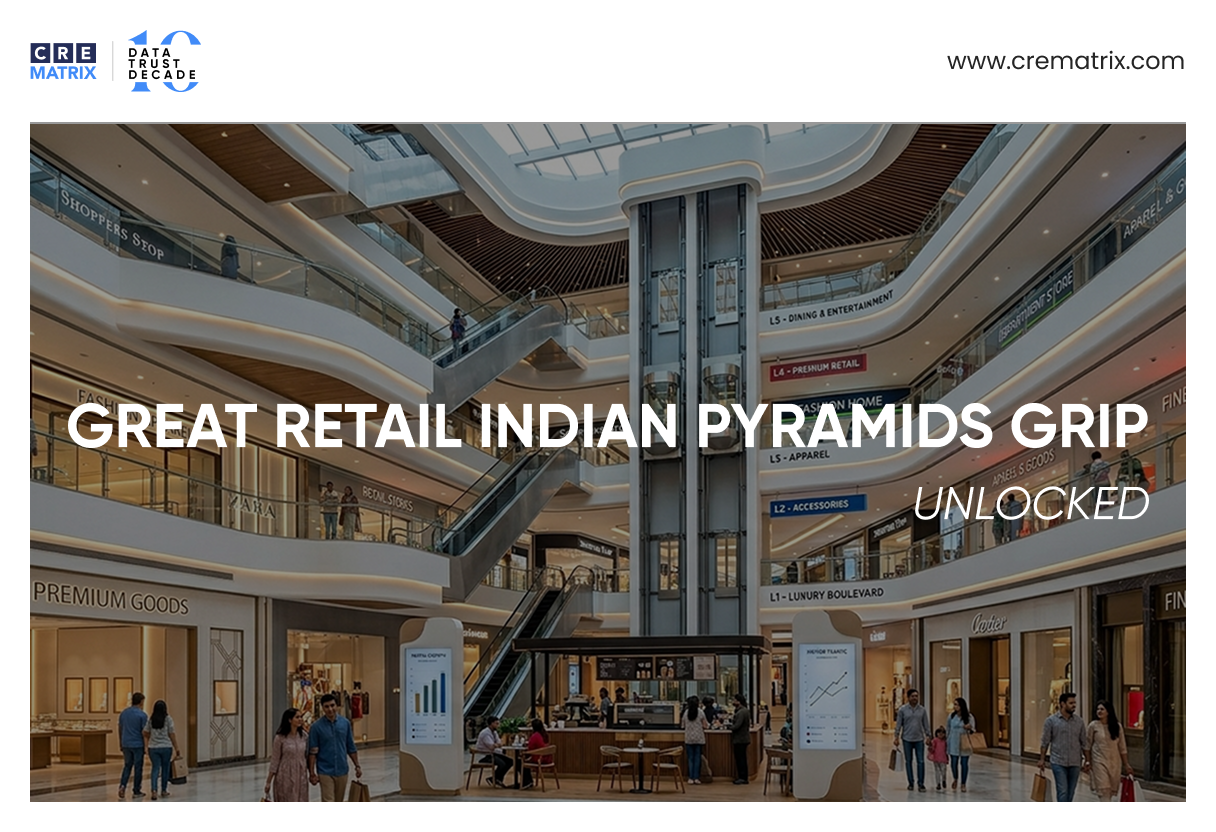
India’s retail landscape is undergoing a seismic shift. No longer just a collection of local markets, it has evolved into a sophisticated ecosystem of massive shopping malls and high-street hubs. The latest GRIP (Great Retail Indian Pyramid) Unlocked report by CRE Matrix provides a first-of-its-kind deep dive into this universe. It categorizes over 7,300 brands across India’s top six cities: Delhi-NCR, MMR (Mumbai), Bengaluru, Hyderabad, Pune, and Chennai.
Here are the key takeaways for developers, retailers, and trend-watchers.
The Shift to the Extremes: A New Brand Hierarchy
The most fascinating discovery in the 2024 report is the “systemic shift towards the extremes”. While the Mid-market segment dominated in 2018 with a 39% share, it has since shrunk to 32% as consumers move toward either premium luxury or high-value deals.
The 2024 Retail Pyramid Breakdown:
- Premium/Bridge (34%): Now the strongest occupier in India, featuring brands like H&M and Adidas.
- Mid-Market (32%): A shrinking middle ground featuring staples like Shoppers Stop.
- Affordable Luxury (14%): Growing steadily alongside high-end tastes.
- Value for Money (13%): Increased from 8% in 2018, led by brands like Reliance Trends.
- Premium Luxury (7%): The top of the pyramid, including elite names like Bvlgari and Cartier.
The Infrastructure: Crossing the 100 Million Square Foot Milestone
The Indian retail sector is rapidly growing, driven by a massive expansion of physical infrastructure. As of the first half of 2024, the built stock of shopping malls across India’s top six cities officially crossed the historic 100 million square feet (msf) milestone. This vast landscape comprises 299 shopping malls accounting for 106 msf, complemented by 65 prominent high streets contributing 11.3 msf.
Additionally, developers have integrated another 14.1 msf of retail space within office and residential complexes, bringing the total urban retail footprint to a scale that is fundamentally reshaping the consumer experience.
Notably, it took 22 years (1991–2013) to reach 50 msf of mall stock, but the second 50 msf was added in just 10 years. Experts predict another 30 msf will be added by the end of 2027—double the construction speed of the last decade.
Rental Hotspots
Rentals vary wildly across categories and cities. Currently, Mumbai’s Top F&B and Delhi’s Value for Money Ethnic Wear brands are paying some of the highest rentals in the country.
- Fast Food (Value for Money): Rentals reach up to ₹1,651 per sqft/month in Pune and ₹1,258 in Mumbai.
- Ethnic Wear (Premium Luxury): In Delhi-NCR, these brands can pay as much as ₹1,900 per sqft/month.
- Electronics: Premium electronics in Mumbai see rentals around ₹1,382 per sqft/month.
Unique Deals & Record Breakers
The report highlights several transactions that have defied market norms:
- Highest Monthly Rental: Zara in Mumbai’s Ismail Building pays a staggering ₹3.19 Crore per month.
- Largest Store: Pantaloons in Mantri Junction Mall, Bengaluru, spans 216,738 sqft.
- Longest Lease: Decathlon in Amanora Mall, Pune, signed a rare 30-year lease.
- Most Expensive Mall Deal: Franck Muller in High Street Phoenix, Mumbai, signed for >₹1,819 per sqft.
Looking to 2030
The retail mix of 2030 will look nothing like today. We are moving toward theme-based malls (like luxury-only or premium outlet centers) and a market where the upper half of the pyramid, Luxury and Premium/Bridge, will see the most aggressive growth. For stakeholders, the message is clear: position yourself in sync with these changing preferences or risk being left behind in the mid-market squeeze.
Elevate your decisions in real estate as a developer or broker with CRE Matrix‘s data-driven insights. Book a demo now!